Samsung Galaxy Z Flip7 vs Motorola Razr 60 Ultra is the comparison that matters most to anyone seeking a premium "flip" foldable without regrets: one leans on cameras and software support, the other on battery, screen and mechanical durability. Both deliver top-end performance and modern connectivity (5G, Wi‑Fi 7, Bluetooth 5.4, NFC), but they differ in the details that truly impact the experience. If you buy it to use for 3-5 years, the update policy and hinge quality weigh as much as the megapixels.
In this article
- General overview: two premium "flips", different priorities
- Architecture & specifications: chips, memory and what that changes
- Screen, battery and hinge experience: the "day-to-day hardware"
- Cameras, image processing and gaming: where Samsung usually wins
- Software, updates and after-sales: the factor that decides in the long term
- What changes for the user: choosing without falling into “spec wars”
- FAQ
General overview: two premium "flips", different priorities
The duel Samsung Galaxy Z Flip7 vs Motorola Razr 60 Ultra takes place in a segment where the engineering of the folding mechanism and software maturity matter more than isolated specifications. Samsung's offering tends to be an "ecosystem product": integration with accessories and services, and more predictable OTA (over-the-air) updates. Motorola, on the other hand, aims to win on tangible hardware: a titanium hinge and a larger battery, with an Android experience closer to stock (a less customised interface).
The text also highlights a practical point that doesn't appear on the showroom floor: foldables live and die by the consistency of after-sales support and the speed with which they receive security patches. In this area, the source text points to an advantage for Samsung in the update cadence, while Motorola is still seen as less consistent.
Architecture & specifications: chips, memory and what that changes
In the Samsung Galaxy Z Flip7 vs Motorola Razr 60 Ultra comparison, raw performance should not be the decisive factor for most users. The Galaxy Z Flip7 uses the Exynos 2500 (Samsung's flagship chip), while the Razr 60 Ultra relies on the Snapdragon 8 Elite Gen 4 (Qualcomm). In practice, both should handle multitasking, video and demanding games well. Differences may emerge in specific scenarios: GPU compatibility and optimisation, energy efficiency under prolonged loads, and for power users, emulation and graphics drivers.
The Razr 60 Ultra can reach 16 GB of RAM and up to 1 TB of storage, whereas the Flip7 is listed with 12 GB of RAM and up to 512 GB. This does not mean the Flip7 "falls short", but it may matter to users who record a lot of video, run heavy editing apps or keep large offline libraries. The extra RAM can also aid aggressive multitasking, although the actual benefit depends on the system and memory management.
Both use LTPO AMOLED foldable displays. LTPO is a technology that allows the refresh rate to vary dynamically to save battery, which is especially useful in a foldable where the display is the main power consumer.
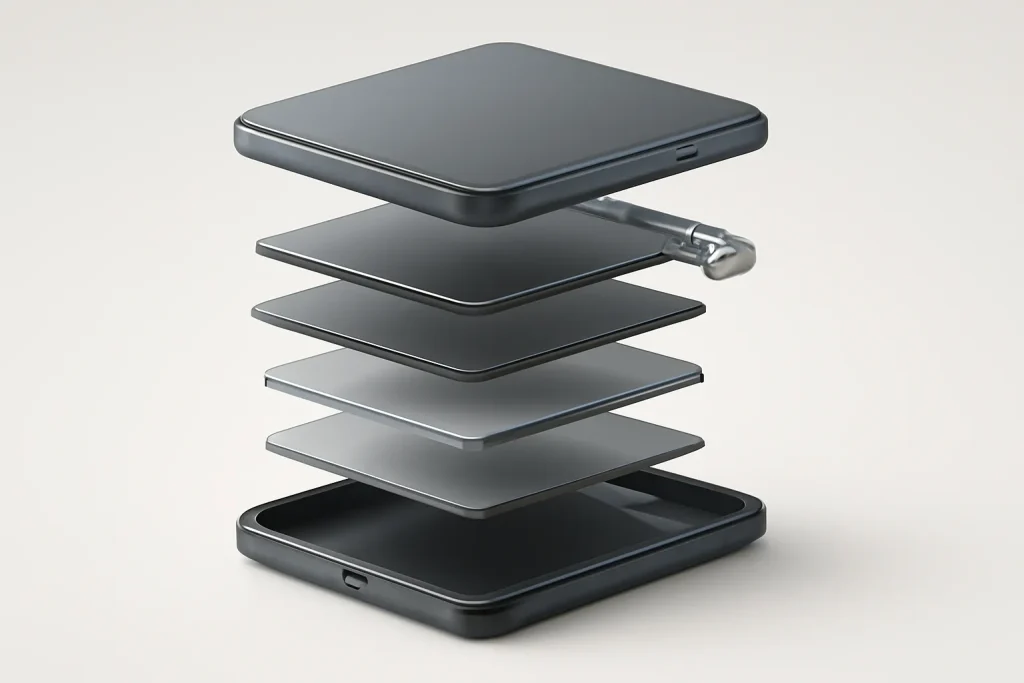
Screen, battery and hinge experience: the "day-to-day hardware"
If your priority is visual comfort and battery life, the Samsung Galaxy Z Flip7 vs Motorola Razr 60 Ultra tilts towards Motorola on two points mentioned in the source text. First, the Razr 60 Ultra would have an advantage in fold visibility and includes DC dimming. DC dimming is a brightness-control technique that can reduce perceived flicker for sensitive users, unlike PWM-based methods. The Flip7 is described as having an excellent screen, but without DC dimming, which may be decisive for those who experience discomfort at low brightness.
In terms of battery, the difference is clear: 4700 mAh in the Razr 60 Ultra versus 4300 mAh in the Flip7. In real-world use, this typically translates to more headroom by the end of the day, especially with 5G and high brightness. Nevertheless, chip efficiency, system optimisation and usage habits (camera, gaming, browsing) can overturn expectations in specific cases.
Regarding durability, Motorola stands out for its titanium hinge, described as more robust. In foldables, the hinge is a critical component: it influences rigidity, the feel when opening/closing and wear tolerance. Samsung retains a "traditional" approach but one that is reputedly well engineered; the question is whether the titanium advantage compensates for your profile (frequent daily openings, uncovered use, exposure to dust).
Cameras, image processing and gaming: where Samsung usually wins
In Samsung Galaxy Z Flip7 vs Motorola Razr 60 Ultra, the megapixel count doesn't tell the whole story. The Flip7 comes with 50 MP + 12 MP, while the Razr 60 Ultra has 50 MP + 50 MP. The source text credits Samsung with better image processing and this tends to translate into more consistent HDR, more stable skin tones and better low-light performance, even with theoretically “inferior” sensors. For those who photograph people, animals and night-time scenes, processing can matter more than the lens on paper.
In games, the expectation is a technical tie: both SoCs are described as capable of running demanding titles. The nuance lies with the Adreno GPU (Qualcomm), often associated with better support in certain emulation scenarios. If your use is primarily “normal” gaming and streaming, the difference may be irrelevant; if you enjoy exploring emulation and compatibility, Motorola could have a practical edge.
Software, updates and after-sales: the factor that decides in the long term
The source text cites Android 16 on the Galaxy Z Flip7 and Android 15 on the Razr 60 Ultra. More important than the original version is the cadence of security and system updates. Here, Samsung Galaxy Z Flip7 vs Motorola Razr 60 Ultra tends to favor Samsung: faster and more consistent OTA updates mean less time exposed to vulnerabilities and a higher likelihood of receiving camera improvements, stability and feature upgrades over time.
On Motorola's side, a less predictable update experience and potential friction with support are noted. This point is especially sensitive for foldables, as repairs can be more complex and costly than with traditional phones. Before deciding, it is worth reviewing warranty conditions and resolution timeframes; as a general reference, check the notes on warranty coverage and processing timelines (criteria and timelines vary by context, but they help structure expectations).

What changes for the user: choosing without falling into “spec wars”
For those who want the best “hardware first” balance - battery life, screen with DC dimming and a potentially more robust hinge - the Razr 60 Ultra appears as the most straightforward choice in the source text. For those who value consistent photography, integration with other devices and greater confidence in updates, the Flip7 justifies the additional investment.
In practice, Samsung Galaxy Z Flip7 vs Motorola Razr 60 Ultra comes down to three questions: (1) are you sensitive to flicker and use low brightness? (2) will you keep the phone for several years and want predictable updates? (3) does your routine require extra battery and mechanical robustness? Answer these and the decision becomes clear. For editorial transparency, the original comparison is in original source.
FAQ
- Samsung Galaxy Z Flip7 vs Motorola Razr 60 Ultra: which is better for those sensitive to screen flicker?
- Based on the source text, the Razr 60 Ultra has DC dimming, which can reduce discomfort associated with flicker at low brightness. In the Flip7, it is noted that there is no DC dimming, potentially making it less comfortable for sensitive users.
- What is DC dimming and why does it matter in a foldable?
- DC dimming is a brightness-control method that can minimise perceptible flicker on some screens. In a foldable, where the display is used for longer periods and in more contexts, this can affect visual fatigue.
- Between the Samsung Galaxy Z Flip7 and the Motorola Razr 60 Ultra, which tends to receive faster updates?
- The source text points to Samsung as the winner in OTA update consistency and speed. For extended use, this may weigh more than minor performance differences.
- Does the titanium hinge on the Razr 60 Ultra ensure greater durability?
- It is an engineering indication focused on strength, and the source text suggests it is more durable than the "traditional" approach of the Flip7. Nonetheless, real durability depends on dust, drops, the number of opening cycles and daily care.
- What is the better choice for photography, despite the megapixel counts?
- According to the source text, the Galaxy Z Flip7 has superior image processing, which usually translates into more consistent HDR and low-light results. The Razr 60 Ultra is not described as weak, merely less strong in "computational photography".
- Is there a clear advantage for gaming and emulation?
- The source text describes similar gaming performance, but gives a slight preference to the Razr 60 Ultra in scenarios involving the Adreno GPU and emulation support. For typical gaming, the difference may be small.
Get more articles like this one.
Refurbished tech analysis + €5 with BEMVINDO5 on your first order.