In this article
- Global overview: what defines the best tablets for kids 2026
- Architecture & Specifications: the technical minimum that avoids headaches
- Ecosystem integration: iPadOS, Android and user profiles
- Privacy issues: accounts, purchases and appropriate content
- What changes for the user: quick recommendations by age and use
- Next steps: final checklist before buying
- FAQ
Global overview: what defines the best tablets for kids 2026
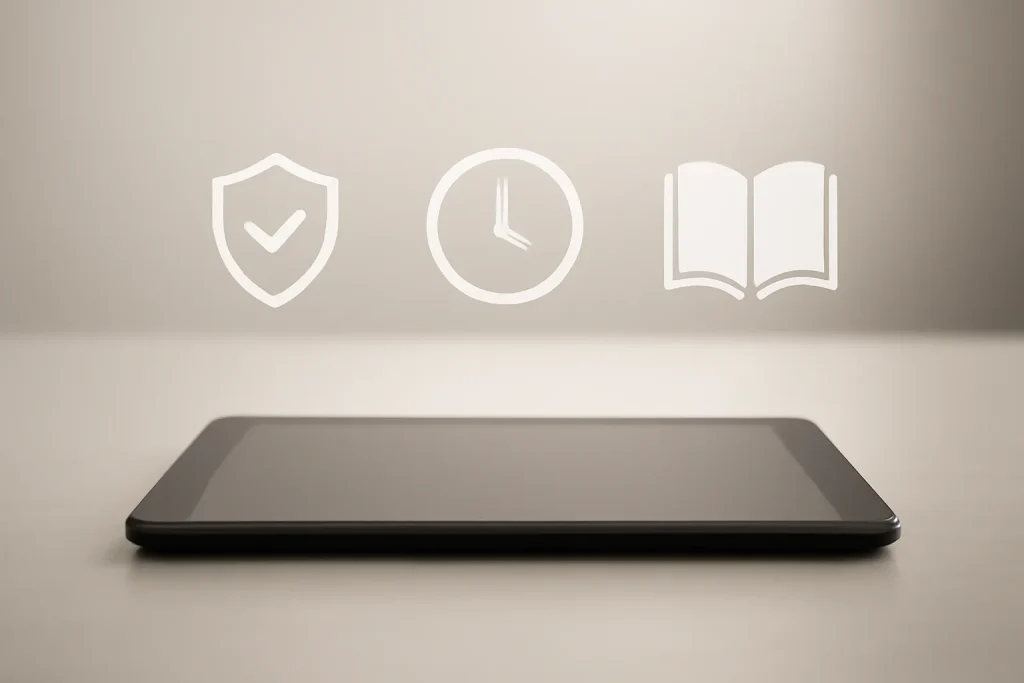
\nWhen talking about the best tablets for kids 2026, three pillars decide the purchase: (1) effective parental controls, (2) consistent performance to avoid frustration, and (3) longevity through updates. “Parental controls” here means screen‑time management, app permissions, content filters and purchase blocking. Without this, the tablet becomes a large phone with added risks.\n\nIt is also useful to distinguish two scenarios: a “grow‑with” tablet (accompanies the child for years, with school and creativity apps) versus a “consumption” tablet (video, reading and light games). The former usually justifies a system with a better app catalogue and accessories; the latter mainly needs a decent screen, decent battery life and a simple interface.\nArchitecture & Specifications: the technical minimum that avoids headaches
\nYou don’t need a flagship model to nail the best tablets for kids 2026, but there are minimums that make a difference day‑to‑day. Start with the screen: an 8‑inch panel with a 1280×800 resolution is a reasonable starting point for comics, video lessons and casual games. Below that, reading becomes tiring and the interface feels cramped.\n\nStorage is the second “Achilles’ heel”. 128 GB (or more) reduces constant space‑management, especially with games and offline downloads for travel. Some games can occupy dozens of gigabytes; when the tablet has little space, the typical result is deleting apps, losing progress and creating household friction. If a microSD slot is present, it is a bonus for storing videos and files, but it does not fully replace fast internal storage.\n\nIn RAM, 4 GB or more tends to ensure smooth app transitions and fewer background reloads. Battery life should be planned for “real‑world days”: lessons, car trips, flights and home use. A powerbank can solve emergencies, but it does not compensate for a tablet that lives tethered to a charger.\n\nFinally, updates. An Android tablet that is old and lacks security patches is a risk: apps stop working, bugs remain unfixed and parental controls can become inconsistent. That is why, in the best tablets for kids 2026, the support policy carries almost as much weight as the technical specs.\n\n
Ecosystem integration: iPadOS, Android and user profiles
\nThe iPad remains a frequent school choice because many institutions and educational apps already support it. In iPadOS, “Screen Time” allows you to set limits, approve installations, block purchases and filter content. An important nuance: iPadOS does not offer multiple user profiles on the same device, which can complicate sharing between adults and children. If the tablet switches between “parent mode” and “child mode”, this detail affects the experience.\n\nOn Android, the standout feature is Google Family Link, which lets you manage apps, impose daily limits and apply restrictions on services such as search and video. Simply put: it is a central panel to “authorise, limit and block”. For many families, this brings Android closer to what is expected of the best tablets for kids 2026, especially when there is more than one child and you want age‑specific rules.\n\nIf the priority is a “school tablet”, consider compatibility with specific apps and web forms. In some contexts, tablets with more closed or consumption‑focused ecosystems can fail at basic productivity tasks. When the school requires particular apps, verify availability and minimum requirements beforehand.\nPrivacy issues: accounts, purchases and appropriate content
\nA children’s tablet is, in practice, a device with access to personal data, microphone, camera and online services. To ensure the best tablets for kids 2026 are more than a list of models, follow simple rules: use a managed child account, disable unauthorised purchases, limit permissions (camera/location) and review the history of installed apps. It is also wise to configure DNS filtering at the router level where possible, adding an extra layer beyond the tablet.\n\nAnother practical decision: whether to allow messaging and video calls. In ecosystems where this is built‑in, it can be useful for talking to family without providing a phone. But it requires discipline: approved contacts, set times and clear rules.\nWhat changes for the user: quick recommendations by age and use
\nFor pre‑school and Year 1, prioritise a simple interface, a sturdy case and easy‑to‑apply time limits. For Years 2 and 3, the conversation shifts: a keyboard, stylus and productivity apps can turn the tablet into an “almost portable” device. If the aim is a device that grows with the child for years, it makes sense to invest in a model with good performance and long‑term support, even if the upfront cost is higher.\n\nIn iOutlet’s editorial, we cross‑reference this topic with broader tablet guides. If you want context to compare formats and ecosystems, see the practical tablet guide 2026 and, for those in the Apple world, the roundup of Best iPads 2026. For a view by usage profiles (including 2-in-1), there is also best tablets 2026 by use.\n\n
Next steps: final checklist before buying
\nTo wrap up the selection of the best tablets for kids 2026, run a quick verification: (1) does the tablet receive regular updates? (2) does it have 128 GB or is it expandable? (3) do the parental controls cover time, apps and purchases? (4) does the school require specific apps? (5) are there suitable cases and accessories? If buying online, also confirm delivery and return terms, to test at home without stress, for example, the rules on returns and warranty . help set expectations.\n\nAs a reference and for editorial transparency, this article adapts recommendations and criteria discussed in the original PCMag source, focusing on what is most relevant for families in Portugal: list of tablets for kids (PCMag). The core remains: more than “cheap”, the best is the one that provides control, safety and room for the child to develop.\nFAQ
- How many inches are ideal in a children’s tablet?
- For most children, an 8" screen is a good balance between portability and visual comfort. Larger screens help with school work and writing, but are less practical to carry.
- Is 128 GB really necessary?
- It is a practical recommendation to avoid running out of space for apps, photos and offline downloads. If the tablet has a microSD slot, it can relieve pressure for videos and files, but it does not always suffice for installing everything.
- What should I set up on day one?
- Create or link a managed child account, activate time limits, block purchases, restrict installations without approval and review permissions (camera, microphone, location) per app.
- iPad or Android: which is easier for parental controls?
- It depends on the scenario. iPadOS has Screen Time well integrated; Android with Family Link makes account management easy and, in many cases, provides profiles and rules per child.
- Is it worth buying a “play tablet” without internet?
- Generally it only makes sense if it has current support and updates. Many “toy tablets” become stuck on old versions and can become insecure and overly limited early on.
- How to tell if it is suitable for school?
- Check with the school which apps and platforms are used (including forms and authentication). Then verify they are available for the chosen system and that the tablet meets the minimum performance requirements.
Get more articles like this one.
Refurbished tech analysis + €5 with BEMVINDO5 on your first order.