In this article
- Overview: two philosophies for the same problem
- Technical details: what the software does when you are not looking
- Architecture & specifications: charging, heat and chemical ageing
- Real-world use cases: which platform fits your day
- Practical advantages: what to do now to make it last longer
- Next steps: how to assess your own battery without myths
- FAQ

Overview: two philosophies for the same problem
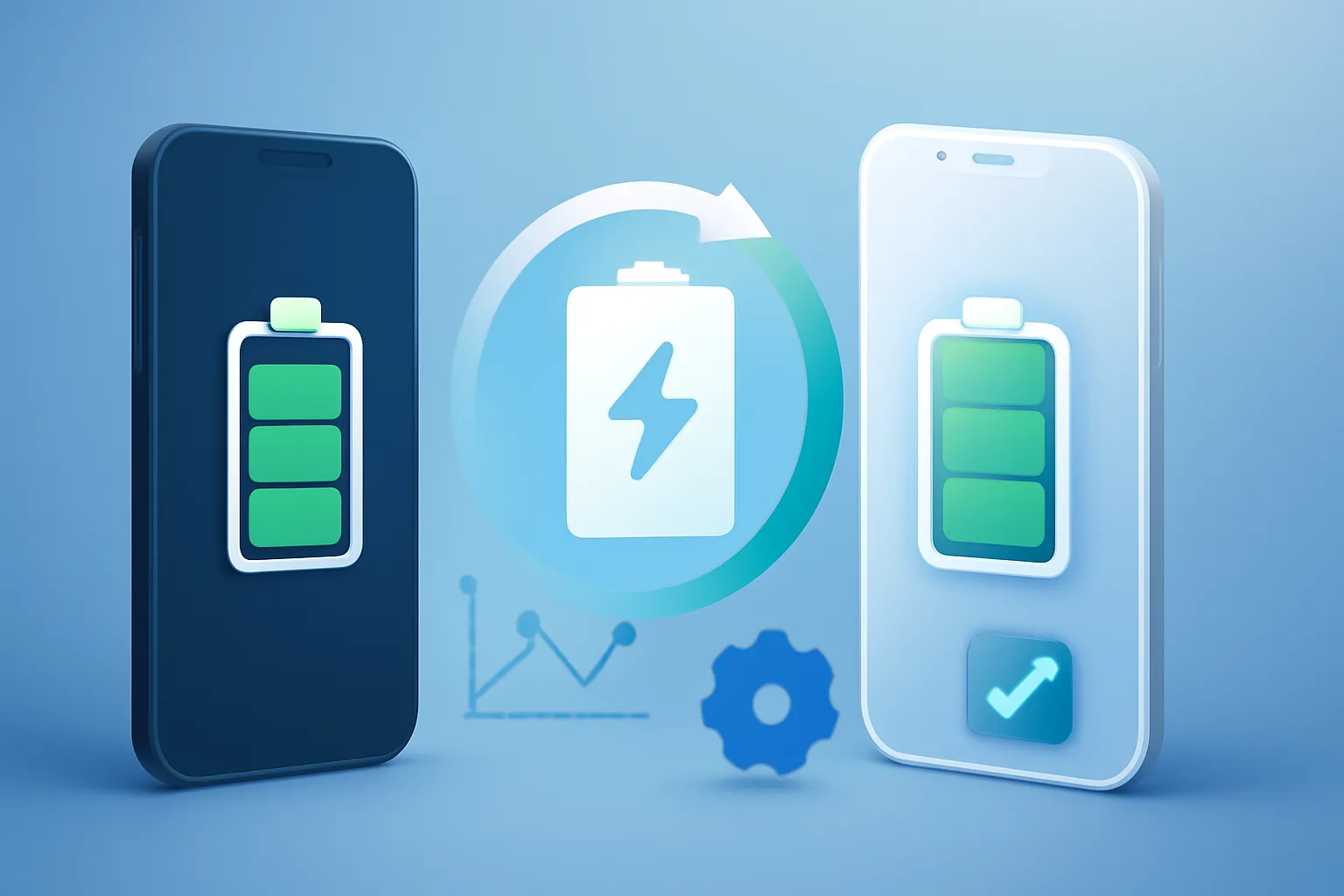
Put simply, Android vs iPhone battery management comes down to a choice between 'more control and more speed' versus 'more automation and more stability'. In the Android ecosystem, each manufacturer combines the operating system with its own set of optimisations, thermal limits and power-saving modes. On the iPhone, Apple controls the complete package (chip, iOS and power policies), which makes it easier to take aggressive decisions about background tasks and performance scaling. The practical effect shows up at three points in the day: overnight (standby drain), during peak usage (gaming, camera, mobile data) and during charging (heat and time plugged in). This is why comparing just 'hours of battery life' can be misleading: two phones can last the whole day for different reasons.Technical details: what the software does when you are not looking
Invisible' consumption mostly comes from background apps, synchronisation and network activity. This is where Android vs iPhone battery management diverges at a fundamental level. On iOS, the system tends to freeze inactive apps and limit background updates, reducing network access when it is not strictly necessary. This usually translates into lower standby drain, because fewer processes are left to 'wake' the phone. On Android, the system uses mechanisms such as Adaptive Battery and Doze Mode to learn usage patterns and put less-used apps into restricted states. Adaptive Battery is a set of policies that tries to predict which apps deserve resources; Doze Mode reduces activity when the device is stationary and not in use. The advantage is that the user (and the manufacturer) can fine-tune things further: restrict specific apps, adjust background execution permissions and choose power-saving modes with different trade-offs. There is a cost: with more freedom and more variation between brands, there are also more scenarios where an app behaves unexpectedly, particularly with persistent notifications, location services and aggressive synchronisation. In practice, Android vs iPhone battery management can be excellent on both platforms, but Android relies more on good configuration and manufacturer optimisations.
Architecture & specifications: charging, heat and chemical ageing
Fast charging is convenient, but a battery is a chemical thing: heat and high voltage accelerate wear. This is where Android vs iPhone battery management becomes more tangible. Many Android phones support high-power charging (varying by brand and model), which cuts time at the wall but can raise temperature during the initial charging phase. Some manufacturers mitigate this with cooling systems, dual-cell charging and algorithms that reduce power when the phone heats up. On the iPhone, the strategy tends to be more conservative: lower power limits and a stronger emphasis on thermal control. Additionally, iOS uses Optimised Battery Charging, a routine that can pause charging near 80% and finish later, aligning with your daily pattern. This reduces the time spent at 100% (a state that, if maintained for many hours, can contribute to ageing). In terms of habits, Android vs iPhone battery management rewards different behaviours: on Android, quick top-ups are part of the design; on the iPhone, the system tries to protect the battery with less user intervention. Another point is wireless charging and extra features. Some Android phones offer reverse charging for accessories; on the iPhone, Apple tends to reserve capacity and power policies for emergency functions and ecosystem reliability. It is not 'better' or 'worse' in itself: it is a choice of priorities.Real-world use cases: which platform fits your day
If your day has short windows for charging (between meetings, commutes, breaks), Android vs iPhone battery management can favour Android, because the combination of larger batteries (on many models) and fast charging reduces wall anxiety. For people who game on their phone, do heavy multitasking or use hotspot a lot, Android can also be appealing because it allows more granular performance profiles and per-app restrictions. If you value predictable standby (for example, you leave the phone untouched for many hours, or you want to wake up to minimal drain), the iPhone is usually strong thanks to aggressive background control and the efficiency of the chip+iOS package. Battery Health metrics also tend to be more consistent across iPhone models, whereas on Android visibility can vary by brand and version, sometimes requiring extra tools. For anyone undecided between high-end models, it is worth cross-referencing this discussion with broader platform and ecosystem comparisons. At iOutlet, you can complement this reading with key differences in premium devices and the framework of consistency vs innovation, because battery is rarely an isolated topic.Practical advantages: what to do now to make it last longer
Regardless of brand, there are three rules that usually improve results without 'tricks': reduce heat, avoid long periods at 100% and control apps that abuse background activity. In Android vs iPhone battery management, this translates into different actions. On the iPhone, it makes sense to keep optimised charging active and use low-power mode when you know you will be many hours without charging. On Android, it is worth reviewing background execution permissions, limiting 'always' location access and using scheduled power-saving modes (for example, overnight). It also helps to separate two concepts: daily battery life and battery health. Battery life is how long it lasts today; health is how long it will last in a year. If you rely on fast charging every day, try to compensate with slower charging when possible and avoid charging in hot environments (sun in the car, cases that trap heat). If you notice sudden drops, it could be a sign of a problematic app, an unstable network (weak 5G increases consumption) or natural degradation.
Next steps: how to assess your own battery without myths
A pragmatic way to decide is to observe one real week: percentage lost overnight, screen-on time, and temperature during charging. If your priority is 'recover hours in minutes', Android vs iPhone battery management tends to favour Android. If your priority is 'set and forget', with less standby drain and conservative charging policies, the iPhone usually aligns better. For editorial transparency, the original piece that prompted this analysis is at Android vs iPhone battery management explained. For details on settings and official options, you can check Apple Support and Google Support.FAQ
- What does 'Android vs iPhone battery management' actually mean?
- It is the set of software and hardware decisions that control background apps, screen brightness/refresh, chip performance and charging strategy to balance battery life, heat and wear.
- Why can standby drain be different between Android and iPhone?
- iOS tends to be more aggressive at freezing apps and limiting background activity; on Android, there is more variation between brands and more permissions/settings that can increase activity when poorly configured.
- Does fast charging always damage the battery?
- It does not 'always damage' it, but it can accelerate wear if it generates frequent heat and if the phone spends too long in high-voltage states. The manufacturer's thermal management and your habits (hot environment, using the phone while charging) matter a lot.
- Is it better to charge to 80% rather than 100%?
- In general, reducing the time spent near 100% can help longevity. On the iPhone, optimised charging tries to do this automatically; on Android, it depends on manufacturer options and your routine.
- Which settings should I check first on Android to improve battery life?
- Start by identifying apps with abnormal consumption, restrict background activity for non-essential apps, review location permissions and adjust screen brightness/refresh to a more efficient mode.
- When should I consider replacing the battery instead of 'optimising'?
- If battery life has dropped persistently, there are unexpected shutdowns or abnormal heating even with light use, it may be physical degradation. In those cases, optimisations help little and a replacement makes more sense.
Get more articles like this one.
Refurbished tech analysis + €5 with BEMVINDO5 on your first order.