In this article
- Overview: what each promises the user
- Architecture & Specifications: where the meaningful differences lie
- Real‑World Use Cases: streaming, notes, editing and gaming
- Limitations & Challenges: build, cameras and battery life without illusion
- Competition & Prices: how to decide based on your profile
- What to do next: quick checklist before you buy
- FAQ

Overview: what each promises the user
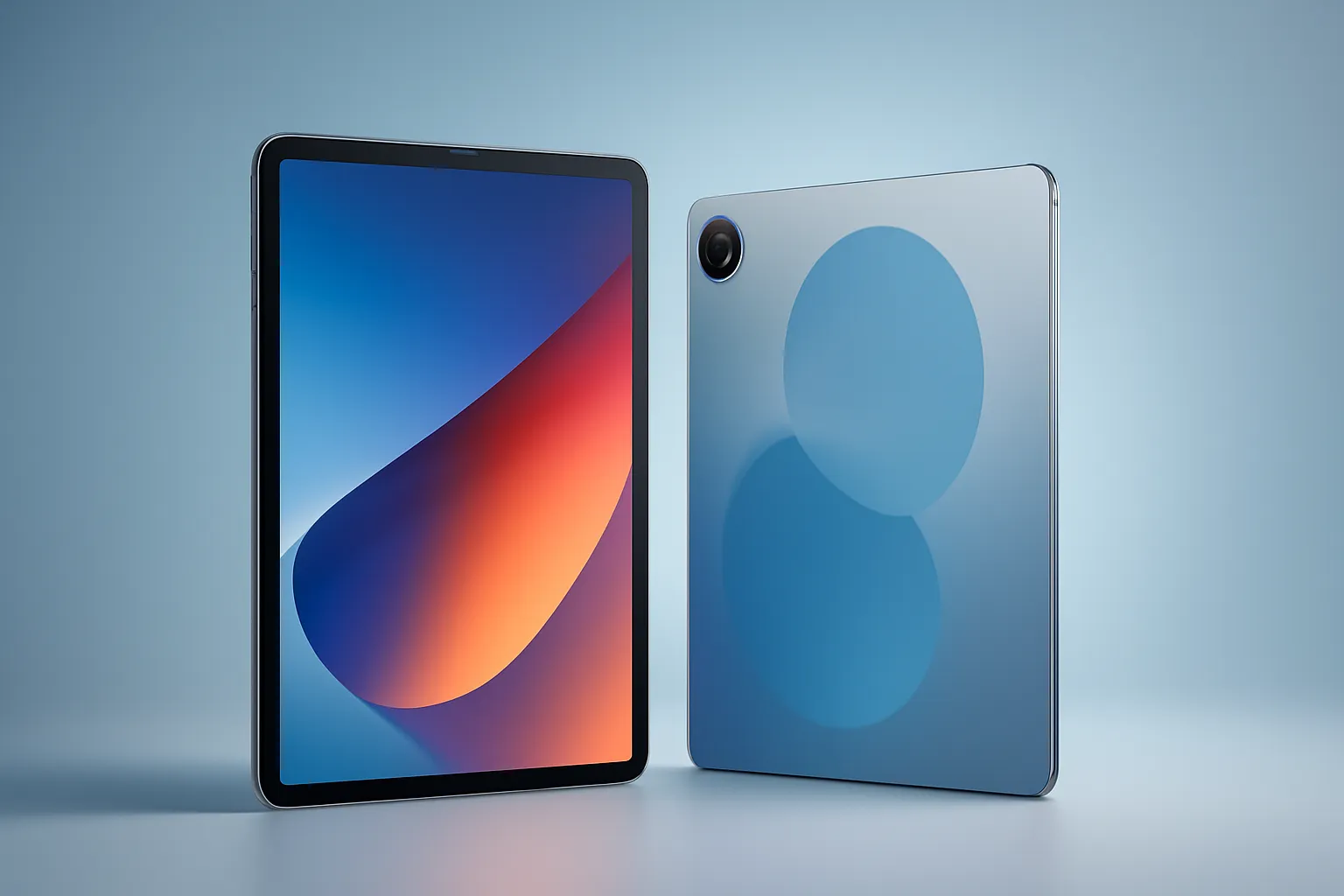
\r\nThe Xiaomi Pad 7 was designed as an entertainment and light‑productivity tablet: large display, high refresh rate and generous battery, running Android 15 and HyperOS 2 that drive multitasking. The iPad 2025 targets creative work and the “tablet as a light computer”, with iPadOS and a very mature app ecosystem for editing, drawing and note‑taking.\r\n\r\nIn the Xiaomi Pad 7 vs iPad 2025 comparison, the useful question isn’t “which is better overall?” but “which fits my workflow?”. A tablet can excel at media consumption and still fall short when the goal is rendering, complex layers in creative apps or more demanding pen latency.\r\nArchitecture & Specifications: where the meaningful differences lie
\r\nOn display, the Xiaomi Pad 7 stands out on paper: an IPS LCD panel of 11,2\", resolution 3K, Dolby Vision support and 144 Hz. The iPad 2025 uses a Liquid Retina IPS LCD of 11" with a stated resolution of 1,5K and 60 Hz. In simple terms, refresh rate is the frequency at which the screen updates the image each second; higher Hz tends to give smoother scrolling and animations. Dolby Vision is an HDR format that improves contrast and gradations in compatible content.\r\n\r\nNow for the “brain”, the story changes. The Xiaomi comes with a Qualcomm Snapdragon 7+ Gen 3; the iPad 2025 uses the Apple A16 Bionic. Without delving into unverified numbers, the tier hierarchy suggests a clear advantage for the A16 in CPU/GPU for heavy tasks and creative apps. This usually translates into faster exports, fewer timeline breaks and more headroom when you open several demanding apps.\r\n\r\nThere are also base differences: the Xiaomi offers 8/12 GB of RAM and 128/256 GB; the iPad lists 6 GB of RAM and 128/256/512 GB. In practice, more RAM helps keep apps in memory and reduces reloads, but the final behaviour depends heavily on the operating system and resource management. It is precisely here that Xiaomi Pad 7 vs iPad 2025 becomes a “philosophy” choice: Android with greater flexibility versus iPadOS with higher consistency and predictability in professional apps.\r\n\r\n
Real‑World Use Cases: streaming, notes, editing and gaming
\r\nFor media consumption, the Xiaomi Pad 7 has strong arguments: higher resolution, 144 Hz and Dolby Vision. In series, sport and browsing, the sense of fluidity tends to be superior, especially in scrolling and animations. For reading and light work, the combination of display and battery also plays in its favour.\r\n\r\nFor creative creation and productivity, the iPad 2025 is generally more predictable. The source text mentions apps such as LumaFusion, Canva, Affinity Designer and GarageBand running more smoothly on the iPad. Even without benchmark numbers, it makes sense: the A16 is a higher‑class chip and iPadOS is designed for this type of workload. In the Xiaomi Pad 7 vs iPad 2025 comparison, this matters if your goal is regular video editing, drawing with many layers or relying on Apple‑specific apps.\r\n\r\nNotes and pen: the original article points to better pen support on the iPad, linked to the Apple Pencil. Here, “better” usually means lower perceived latency, better palm rejection and more consistent integration with note‑taking and drawing apps. Still, if your use is highlighting PDFs and occasional notes, the Xiaomi can hold its own, depending on the accessory and app chosen.\r\n\r\nGaming: the iPad tends to win in raw performance and stability in heavy titles. The Xiaomi is not weak, but the iPad’s performance ceiling is higher. If you mainly play casual titles and cloud gaming, the 144 Hz display can be a Xiaomi advantage, provided the game supports high refresh rates.\r\nLimitations & Challenges: build, cameras and battery life without illusion
\r\nBoth use an aluminium unibody, which is good for rigidity and durability. The source text notes that the iPad has glass that is more scratch‑resistant and an oleophobic coating (reducing finger marks), giving it a slight edge in the “finished product” feel and daily wear.\r\n\r\nRegarding cameras, no tablet is bought “for photography”, but the front camera matters for video calls. The text points to good quality on both, with the iPad having an advantage in detail and noise, and with Centre Stage (automatic framing) helping in calls while you move. If you hold frequent meetings, this difference can be more relevant than it appears in a specifications comparison.\r\n\r\nBattery and charging: the Xiaomi offers 8.850 mAh and the iPad is described with 28,93 Wh, both with 45 W wired charging. The article says the Xiaomi lasts about an hour longer and charges more quickly. As Wh and mAh are not directly comparable without voltage, what matters is real‑world behaviour: if you prioritise longevity away from a socket, the Xiaomi may have the advantage; if you prioritise steady performance under load, the iPad can remain more stable in long tasks.\r\nCompetition & Prices: how to decide based on your profile
\r\nThe source text lists the Xiaomi Pad 7 starting at ₹27.999 and the iPad 2025 at ₹33.990 (Indian market prices). In Portugal, prices and configurations can vary widely, so use these numbers only as a relative reference: the iPad tends to cost more, and part of that differential usually goes towards performance, ecosystem and app support.\r\n\r\nA simple method to finalise the decision Xiaomi Pad 7 vs iPad 2025:\r\n\r\n Choose the iPad 2025 if: you depend on creative apps, want the best overall performance, value video calls and want a more consistent pen experience.\r\n\r\n Choose the Xiaomi Pad 7 if: you want the best display for the money, prioritise fluidity (144 Hz), battery life and charging, and your use is mainly entertainment, study and light multitasking.\r\n\r\nIf you are considering a tablet for several years, it is also worth thinking about support and post‑sale policies. In iOutlet’s editorial context, it makes sense to know how warranty conditions and return policies before finalising the purchase, whatever the ecosystem.\r\n\r\n
What to do next: quick checklist before you buy
\r\nBefore deciding between Xiaomi Pad 7 vs iPad 2025, confirm three points: (1) the essential apps you use (and whether they exist on the platform with the same functionality), (2) the total cost of accessories (keyboard case and pen can change the equation), and (3) your real “usage mode”: couch and travel favour display and battery; desk and creation favour performance and software.\r\n\r\nFor a broader view of the current landscape, you can also cross‑reference this comparison with iOutlet’s guide on best tablets 2025to see where each model fits against alternatives and productivity formats.\r\n\r\nSource consulted for this adaptation: original comparison.FAQ
- Does the Xiaomi Pad 7 actually have a visible advantage on the screen?
- In theory, yes: 3K, 144 Hz and Dolby Vision promote sharpness and fluidity. The difference is most noticeable in scrolling, animations and HDR‑compatible content.
- For taking notes at university, which makes more sense?
- It depends on your method. If you want the most consistent pen experience and highly polished note‑taking apps, the iPad 2025 is the safer bet. If the focus is reading PDFs, occasional note‑taking and a good display, the Xiaomi Pad 7 can hold its own.
- Which is better for video editing and design?
- The iPad 2025, thanks to the Apple A16 Bionic chip and the creative app ecosystem mentioned in the source text. For occasional editing, the Xiaomi can suffice, but with less headroom on heavy projects.
- Do the cameras matter on a tablet?
- The rear camera is usually secondary, but the front one is critical for video calls. The source text gives the iPad 2025 an edge in detail, noise and the Centre Stage feature for keeping framing.
- How to compare 8.850 mAh with 28,93 Wh?
- It is not a direct comparison without knowing the battery voltage. The most reliable approach is to look at endurance tests and your own usage; the source text suggests roughly an extra hour for the Xiaomi Pad 7.
- What should I confirm before buying online?
- Check delivery times and return policies, as well as warranty coverage and the condition of the device. In Portugal, these factors can weigh as heavily as the technical specifications.
Get more articles like this one.
Refurbished tech analysis + €5 with BEMVINDO5 on your first order.