In this article
- Global View: why a set-top box can beat the TV's smart system
- Technical Details: tvOS, dedicated hardware and app consistency
- Ecosystem Integration: HomePod, AirPods, FaceTime and AirPlay
- Privacy Issues: less advertising on the interface and more control
- Practical Advantages: extending the life of the TV and reducing unnecessary swaps
- Next Steps: how to decide without overcomplicating it
- FAQ
Global View: why a set-top box can beat the TV's smart system
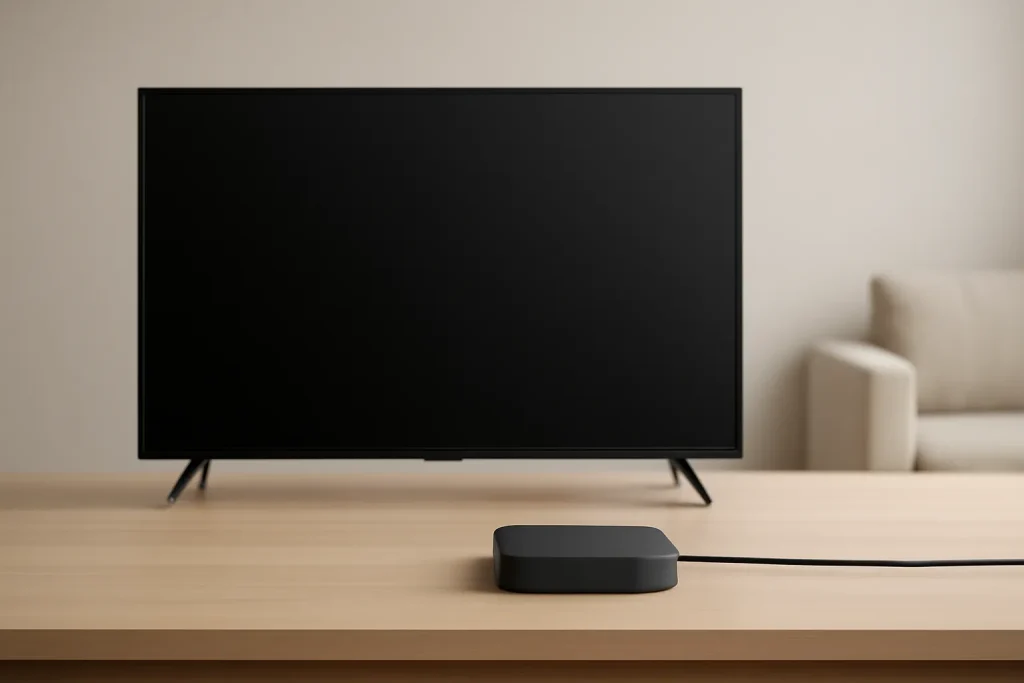
Smart TVs have come a long way, but they still have a structural problem: the software and apps are tied to the television manufacturer's lifecycle. That means irregular updates, cluttered interfaces and, over time, sluggishness. This is where the advantages of Apple TV over smart TV become clearest: the Apple TV is a dedicated device with an operating system (tvOS) designed to be fast, predictable and consistent across different models. In practice, this reduces the variability you get between TVs from different ranges and years. An app might run reasonably well on a recent TV and drag on a four-year-old one; on an Apple TV, the behaviour tends to be more uniform because the hardware target is tighter. This is not magic: final picture quality still depends on the panel and the TV's processing, but navigation, app launch speed and streaming stability depend less on the television's brain. For editorial transparency, this article adapts and expands on the topic from the original BGR piece: comparison of Apple TV vs smart TV.Technical Details: tvOS, dedicated hardware and app consistency
One of the advantages of Apple TV over smart TV is tvOS, the operating system of the Apple TV. Short definition: tvOS is Apple's platform for television, optimised for remote navigation, streaming apps and integration with Apple services. The critical point is not just the good-looking interface; it is the combination of software and dedicated hardware, fine-tuned for a small set of models. This has practical effects: 1) Less fragmentation for developers. On smart TVs, apps have to deal with multiple systems (and versions), different chipsets and memory constraints. The result can be an uneven experience, even within the same brand. On Apple TV, the target is more uniform, which tends to reduce bugs and stutters. 2) Fast setup and syncing. The Apple TV can use the iPhone to speed up setup and sync elements from the Apple Account (apps, purchases, photos and settings). This is particularly useful for anyone moving house, swapping TVs or wanting to replicate the experience in more than one room. 3) Control and continuity. The remote (Siri Remote) and the iPhone act as a bridge for search, control and text entry. It might seem like a small thing, but it reduces daily friction: less time on slow on-screen keyboards, more time watching content.
Ecosystem Integration: HomePod, AirPods, FaceTime and AirPlay
For those already living in the Apple ecosystem, the advantages of Apple TV over smart TV stop being abstract and become concrete features. A strong example is audio: the Apple TV lets you set a pair of HomePods as the main output. Short definition: eARC (Enhanced Audio Return Channel) is an HDMI feature that sends high-quality audio from the TV to an external system with better sync and support for more formats. With an eARC-compatible TV, the logic changes: the HomePods can act as the television's speakers not only for streaming but also for other sources connected to the TV (such as consoles), depending on the setup. For someone who doesn't want to build a home cinema system with an AV receiver, this can be an interesting compromise between simplicity and quality. There are other integrations that weigh on the decision: AirPods: fast pairing and, in many scenarios, a more consistent audio experience than the generic Bluetooth connection on TVs. FaceTime on the big screen: on recent models, the Apple TV can use the iPhone as a camera, bringing video calls to the living room without relying on half-supported apps on the smart TV. AirPlay: screen sharing and audio/video streaming from iPhone, iPad or Mac without the uncertainty of varying compatibility between brands. Even when a TV advertises support, the implementation is not always the same. Whether this integration is decisive depends on your device lineup. But for Apple users, it is one of the advantages of Apple TV over smart TV that is hardest to replicate with other boxes.Privacy Issues: less advertising on the interface and more control
Another area where the advantages of Apple TV over smart TV show is privacy and interface hygiene. Many smart TVs have turned the home screen into a panel of recommendations and sponsored content. Even when that doesn't stop you using the TV, it adds noise and the feeling that the TV is competing for your attention. On Apple TV, the experience tends to be more focused on the installed apps and what the user chooses to open. Apple still collects data (like any modern platform), but, according to the company, it does not sell it to third parties and gives configuration options during setup. If you want to review settings and permissions, the official documentation can help you find the relevant menus and options: Apple's official support. It is important to separate two things: privacy is not zero collection, and ads are not zero recommendations. The point is the degree of control and how advertising enters (or doesn't enter) the main usage flow. For many people, this alone justifies the advantages of Apple TV over smart TV.Practical Advantages: extending the life of the TV and reducing unnecessary swaps
A smart TV ages like a cheap computer: the panel may still be good, but the system slows down, apps stop updating and the experience degrades. Here, the advantages of Apple TV over smart TV are almost a separation of concerns strategy: you let the TV do what it does best (picture) and hand the smart part to a dedicated device. The result can be a more rational upgrade cycle. Instead of swapping your television because the interface is slow or an app no longer works well, you can keep the panel and upgrade only the box when it makes sense. Even if you later move it to another room or give it away, reusing the setup is simpler than recycling an entire smart TV because of the software. If you are planning technology purchases with a focus on longevity and support, it is also worth keeping warranty policies and return periods in mind. In iOutlet's editorial context, you can consult warranty conditions and return rules to set expectations (especially for refurbished items).
Next Steps: how to decide without overcomplicating it
Before you buy, ask yourself three simple questions: (1) is your TV slow or full of advertising on the home screen? (2) do you use an iPhone, AirPods or HomePod and want friction-free integration? (3) do you value updates and app consistency more than the TV manufacturer's features? If you answered yes to two of them, the advantages of Apple TV over smart TV tend to pay off. If your smart TV is recent, fast and has a system you like, the Apple TV may be redundant. But if the goal is to stabilise the streaming experience, reduce clutter and gain Apple integration, the set-top box works as an upgrade that doesn't force you to swap your panel.FAQ
- Does the Apple TV improve my television's picture quality?
- It can improve streaming consistency and app smoothness, but the final picture quality still depends on the panel and the TV's processing. The Apple TV doesn't turn a weak panel into a high-end one.
- Do I need a TV with HDMI 2.1 to use Apple TV?
- Not necessarily. The essential thing is having an HDMI input. HDMI 2.1 may be relevant for certain features (depending on the TV and your use), but it is not a universal requirement for streaming.
- What is eARC and why is it important with HomePod?
- eARC (Enhanced Audio Return Channel) is an HDMI feature that sends high-quality audio from the TV to an external system. With eARC, it is more viable to use HomePods as the TV's main audio output, with better compatibility and sync.
- Does the Apple TV have ads on the home screen?
- Generally, the experience is cleaner than on many smart TVs, with a focus on installed apps. Even so, there may be recommendations and promotions inside apps and services, which is different from forced advertising on the main interface.
- Is it worth it for someone who doesn't have an iPhone?
- It can be worth it for tvOS stability and app consistency, but part of the advantages (fast setup, AirPlay, HomePod/AirPods integration) loses impact outside the Apple ecosystem.
- Is using an Apple TV a way to extend the life of an old smart TV?
- Yes, often. By using the Apple TV for apps and streaming, you stop relying on the TV's system, which tends to age worse. The TV becomes more of a monitor and less of a computer.
Get more articles like this one.
Refurbished tech analysis + €5 with BEMVINDO5 on your first order.