In this article
- Overall View: two foldables, two philosophies
- Architecture & Specifications: what actually changes
- Technical Details: screens and ergonomics (where the decision is won)
- Real‑World Use Cases: work, entertainment and mobility
- Limitations & Challenges: battery, charging and cameras
- What changes for the user: how to choose without regrets
- FAQ

Overall View: two foldables, two philosophies
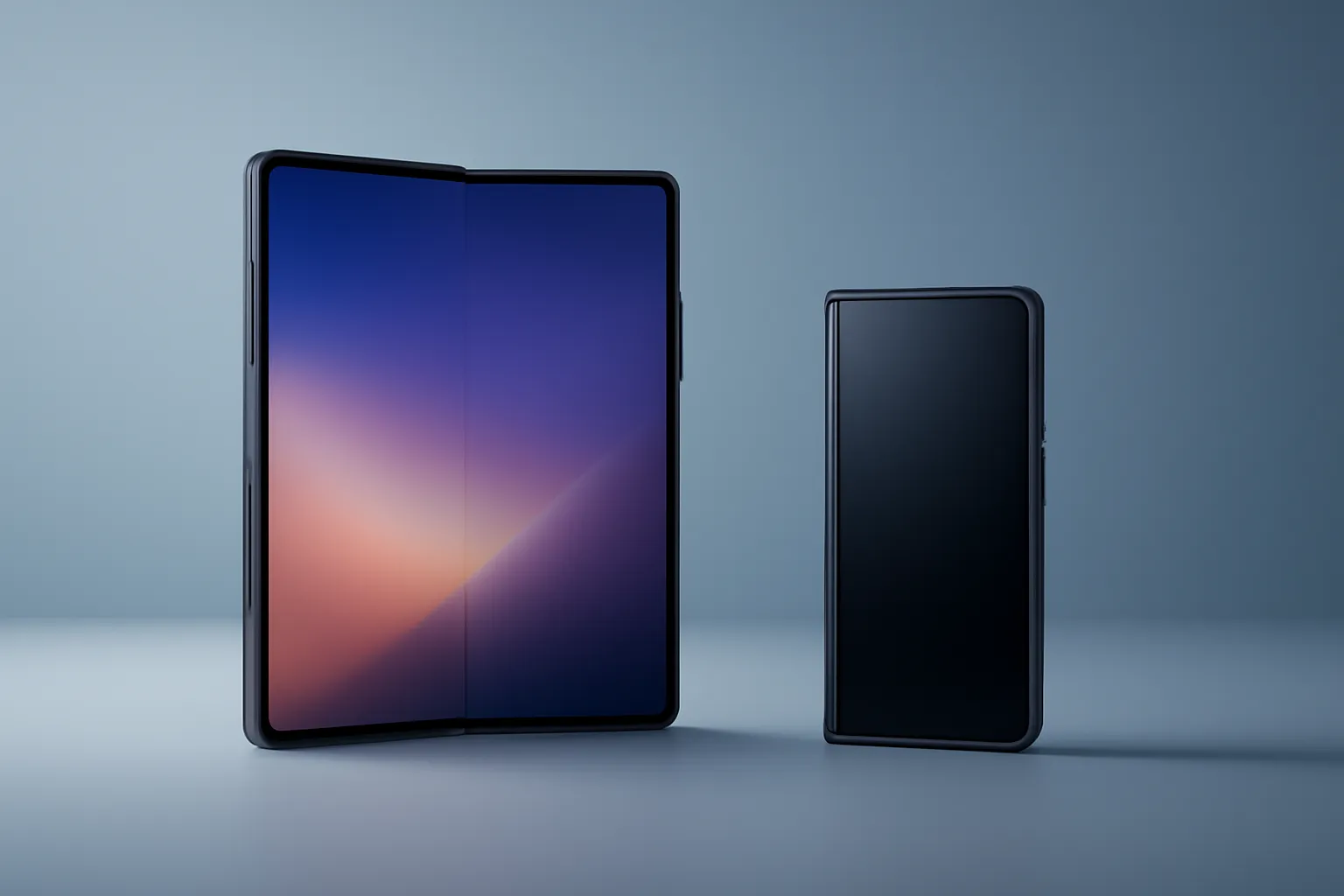
\r\nAlthough both are foldable, their starting point differs. The Galaxy Z Fold 7 follows a “book‑style” concept: it opens like a book and offers an internal screen of 8 inches, keeping a relatively slim profile when closed. The Galaxy Z TriFold adds a third folding section to reach 10 inches on the main panel, bringing it closer to a mini‑tablet when fully opened.\r\n\r\nIn practice, Samsung Galaxy Z TriFold vs Galaxy Z Fold 7 isn’t about “which is better”, but “which is more suitable”. The TriFold appears aimed at those who want maximum workspace and reading area; the Fold 7 remains the easier option to carry in a pocket or hand.\r\nArchitecture & Specifications: what actually changes
\r\nThere is an immediate contrast in dimensions and weight. The TriFold is substantially heavier (309 g) than the Fold 7 (215 g). It is also thicker when closed, although the opened devices are similar in thickness. This detail is decisive: comfort during prolonged use and “real portability” depend more on weight and thickness than on an extra half‑inch.\r\n\r\nIn durability, both come with an IP48 certification (water and dust). This is an important point for foldables: IP48 does not mean immunity to fine dust as in a typical IP68; it does indicate a meaningful level of protection against common accidents, but without promising invulnerability.\r\n\r\nIn materials, the approaches differ. The Fold 7 uses a glass rear, whereas the TriFold employs a polymer reinforced with fibre and ceramic/glass (according to the source description). This suggests distinct priorities: premium aesthetics and feel on the Fold 7; robustness and weight/structure management on the TriFold.\r\n\r\nIn terms of performance, Samsung Galaxy Z TriFold vs Galaxy Z Fold 7 is almost a technical dead‑heat: both use the Qualcomm Snapdragon 8 Elite for Galaxy. The TriFold is listed with 16 GB of RAM and up to 1 TB; the Fold 7 appears with 12 GB (LPDDR5X) and UFS storage 4.0 up to 512 GB in the specifications, although the text also mentions configurations up to 16 GB/1 TB. Without independent testing and a complete official spec sheet, the safest assumption is that the experience will be similar and that variations may depend on market.\r\n\r\n
Technical Details: screens and ergonomics (where the decision is won)
\r\nThe screen is the central argument. The TriFold offers a main panel of 10 inches (Dynamic LTPO AMOLED 2X, 120 Hz) and a cover screen of 6,5 inches, also LTPO at 120 Hz. The Fold 7 combines an internal screen of 8 inches (Dynamic AMOLED 2X, 1‑120 Hz) and an external screen of 6,5 inches (1‑120 Hz). LTPO is a back‑plane technology that allows the refresh rate to vary to save power, adapting to the displayed content.\r\n\r\nAt peak brightness, the text cites 1.600 nits on the TriFold’s main panel and 2.600 nits on the Fold’s main panel 7, with 2.600 nits on the TriFold’s cover screen and also on the Fold’s 7. If you use the foldable outdoors in bright sun, this may be the most “felt” advantage for the Fold 7, even with less useful area.\r\n\r\nThere is also a format detail: the TriFold uses an aspect 4:3 on the main screen, closer to a tablet, which tends to favour reading, documents and some apps in multi‑window mode. The Fold 7, with 8 inches, remains excellent for multitasking, but offers less space for two apps side‑by‑side without compromising font size.\r\n\r\nIn short, Samsung Galaxy Z TriFold vs Galaxy Z Fold 7 is an ergonomic choice: the TriFold wins on “work desk”; the Fold 7 wins on “device you always carry”.\r\nReal‑World Use Cases: work, entertainment and mobility
\r\nFor productivity, the TriFold has an obvious advantage when fully opened: more space to edit spreadsheets, review PDFs, or keep chat plus document side‑by‑side. It can also be more comfortable for drawing and note‑taking, although that depends on accessories and a pen holder (not detailed in the source).\r\n\r\nFor entertainment, the 10‑inch gain is real, but not all content scales well. Video at 16:9 can leave larger black bars on a 4:3 screen. In gaming, both should perform well thanks to the same chipset; the difference will be more about thermal control and how each dissipates heat, something only prolonged testing can confirm.\r\n\r\nFor mobility, the Fold 7 has a hard‑to‑ignore advantage: 215 g remain heavy for a smartphone, but 309 g enter the realm of “you always feel it in your hand”. If your use is mainly standing, on transport, or with one hand, this is the kind of detail that decides Samsung Galaxy Z TriFold vs Galaxy Z Fold 7 without looking at anything else.\r\nLimitations & Challenges: battery, charging and cameras
\r\nIn the battery department, the TriFold carries 5.600 mAh, while the Fold 7 sits at 4.400 mAh. Greater capacity helps, but does not guarantee longer endurance: a larger screen can consume more, and power management in foldables is complex. Still, it is reasonable to expect the TriFold to have more headroom on long days, especially when multitasking.\r\n\r\nIn charging, the TriFold supports 45 W via cable, while the Fold 7 is limited to 25 W; both maintain 15 W wireless and 4,5 W reverse charging. For those topping up mid‑day, the power difference can translate to less time tethered to a socket, although the real impact depends on charging curves and temperature.\r\n\r\nIn the cameras, the story is less exciting: the text states the hardware is “completely identical” between the two. There is a primary sensor of 200 MP, an ultra‑wide sensor of 12 MP and a telephoto of 10 MP (3x). The source analysis is clear: the primary is solid; the telephoto and ultra‑wide lag behind, especially in low light. In other words, Samsung Galaxy Z TriFold vs Galaxy Z Fold 7 is not decided by photography, it is decided by form factor and use.\r\n\r\n
What changes for the user: how to choose without regrets
\r\nIf you want a “folding tablet” and value workspace above all else, the TriFold appears the right bet, accepting the cost in weight and volume. If you are looking for a foldable to use daily as your primary phone, the Fold 7 remains the most balanced compromise.\r\n\r\nBefore deciding, it’s worth asking two practical questions: will you actually open the large screen several times a day, or only on occasion? And can you live with 309 g in your pocket and hand? With foldables, the answer to these two questions is often more important than any spec sheet.\r\n\r\nFor additional context on the TriFold’s positioning against other formats, you can cross‑reference this analysis with key differences versus the Mate XTs. For editorial transparency, the original comparison is in Phone Comparisons (Android Headlines). And if you are considering a foldable, it makes sense to also review how warranty conditions and return policy, because the post‑purchase experience matters more in devices with moving parts.\r\nFAQ
- Does the Samsung Galaxy Z TriFold vs Galaxy Z Fold 7 have real performance differences?
- In theory, not many: both use the Snapdragon 8 Elite for Galaxy. Practical differences are likely to stem more from thermal management, software and RAM/storage variants by market.
- Does the TriFold last longer on battery simply because it has 5.600 mAh?
- It isn’t guaranteed. The larger screen can increase consumption. The larger capacity provides headroom, but final endurance depends on brightness, time on the internal screen and optimisation.
- Which is more comfortable to use as a “normal” mobile phone day‑to‑day?
- The Fold 7 tends to be more comfortable as it is considerably lighter (215 g) and less bulky when closed. In the Samsung Galaxy Z TriFold vs Galaxy Z Fold 7, this is one of the most decisive factors.
- Are the cameras different between the TriFold and Fold 7?
- The source text states the hardware is essentially the same (200 MP + 12 MP ultra‑wide + 10 MP telephoto). The choice should not be made with photography in mind.
- Does screen brightness really matter in this comparison?
- Yes, if you use the foldable outdoors. The text cites 2.600 nits on the Fold’s main screen 7 and 1.600 nits on the TriFold’s, which may give the Fold 7 an advantage in direct sunlight.
- Is there any extra risk from being a tri‑fold?
- There is additional mechanical complexity and more folding areas, which can increase susceptibility to wear and particles. The IP48 certification helps, but does not eliminate basic care.
Get more articles like this one.
Refurbished tech analysis + €5 with BEMVINDO5 on your first order.