In this article
- General overview: what each tri-fold is trying to solve
- Architecture & specifications: screens, folds and durability
- Performance and longevity: Snapdragon 8 Elite vs Kirin 9020
- Battery and charging: same battery, different rhythms
- Cameras and audio: different priorities, results still unproven
- What it means for the user: how to choose without falling for the spec sheet
- FAQ

General overview: what each tri-fold is trying to solve
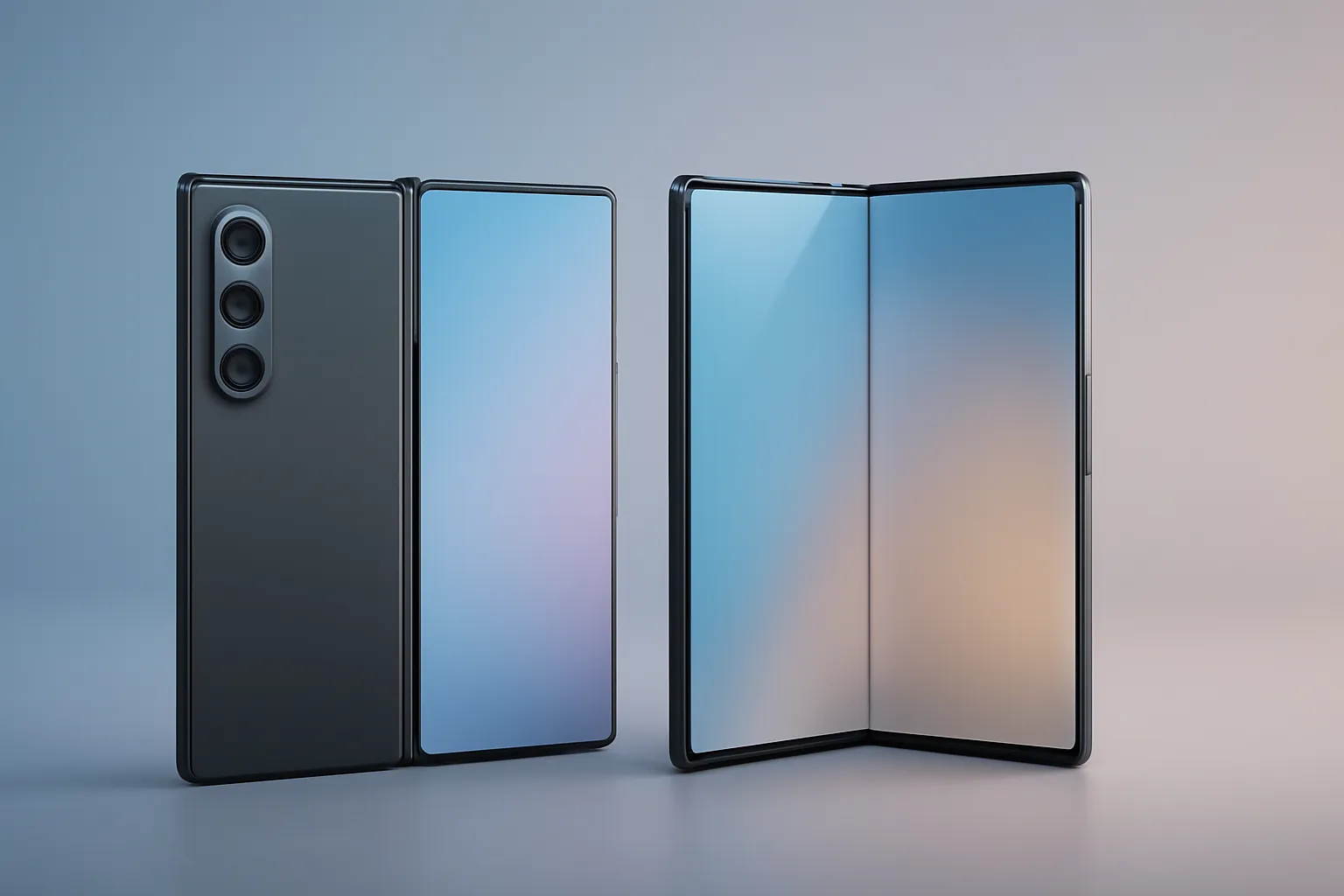
Even though both are tri-folds, the mechanics of use are different. In the Samsung Galaxy Z TriFold vs Huawei Mate XTs, Samsung separates functions: a large main screen for "tablet mode" and a dedicated cover screen for quick use. Huawei, on the other hand, uses a single screen that transforms into three formats (10,2, 7,9 and 6,4 inches), which offers more flexibility but means the panel is exposed more often. In terms of dimensions, the two are similar when folded (comparable thickness) and also when opened, but the weight tips towards the Huawei (298 g) versus the Samsung (309 g). With tri-folds, those grams matter: more mass means more inertia when opening and closing and greater fatigue during prolonged use, especially for reading and video. For editorial transparency, the base comparison and specification table come from the original source: full comparison on Phone Comparisons.Architecture & specifications: screens, folds and durability
The most decisive point in the Samsung Galaxy Z TriFold vs Huawei Mate XTs is the "screen design". Samsung includes two panels: a main 10" Dynamic LTPO AMOLED at 2X to 120 Hz and a cover screen at 6,5" also at 120 Hz. LTPO is a backplane technology that allows the refresh rate to vary to save power, useful on a device with multiple screen modes. Huawei opts for a single LTPO OLED at 10,2" and 90 Hz, which folds down to 7,9" or 6,4". This approach has an obvious advantage: more intermediate formats without "jumping" between smartphone and tablet. On the downside, the exposure of the panel when folded can increase anxiety about scratches and micro-abrasions, even with good coatings. There is also a detail with real-world impact: Samsung indicates an IP48 rating (protection against ingress of dust particles larger than 1 mm and water resistance). Huawei does not offer an equivalent rating in the source material. IP is not a free pass for the beach or pool, but it changes the risk profile in common accidents (rain, spills, pocket dust). If durability and peace of mind matter, this is a strong argument for Samsung in the Samsung Galaxy Z TriFold vs Huawei Mate XTs. On screen specs, Samsung wins on smoothness (120 Hz) and Huawei on resolution and usable area (10,2" and higher resolution in open mode). In practice, 90 Hz is still smooth; 120 Hz tends to be more noticeable in fast scrolling and gaming, but can also hurt battery life if not managed well.
Performance and longevity: Snapdragon 8 Elite vs Kirin 9020
In performance, the Samsung Galaxy Z TriFold vs Huawei Mate XTs is asymmetric on paper. Samsung uses the Qualcomm Snapdragon 8 Elite for Galaxy (3 nm) with 16 GB of RAM. Huawei uses the Kirin 9020 (7 nm) also with 16 GB. Without published benchmarks in the source text, its not worth promising specific numbers; even so, the difference in manufacturing process (3 nm vs 7 nm) usually translates into better energy efficiency and thermal headroom for heavy tasks. The most likely impact is felt in three scenarios: multitasking on a large screen (several apps side by side), video and photo editing, and demanding games. Tri-folds invite you to use more windows and more screen time; if the SoC is less efficient, the device may heat up sooner and throttle performance to control temperature. Storage: Samsung offers 512 GB/1 TB; Huawei offers 256 GB/512 GB/1 TB. Neither mentions card expansion. For a tri-fold, this matters because "tablet-like" use encourages larger downloads (offline content, work files, video), and managing space becomes a recurring issue.Battery and charging: same battery, different rhythms
Both models list 5.600 mAh. On a tri-fold, battery life is less predictable than on a traditional smartphone because it depends on the screen mode being used (10" consumes more than 6,4, 6,5"). So, when looking at the Samsung Galaxy Z TriFold vs Huawei Mate XTs, it makes more sense to focus on charging and habits: people who use the large screen a lot tend to value fast and frequent refills. Here, Huawei stands out: 66 W wired and 50 W wireless, plus reverse wireless (7,5 W) and reverse wired (5 W). Samsung sticks with 45 W wired, 15 W wireless and reverse wireless (4,5 W). For those who use wireless charging at the office or at home, 50 W can change the routine; for those who charge overnight, the difference matters less. The source text mentions that neither has built-in magnets. This could limit magnetic accessories and alignment on stands, depending on each ecosystem.Cameras and audio: different priorities, results still unproven
In photography, the Samsung Galaxy Z TriFold vs Huawei Mate XTs is once again a comparison of philosophies. Samsung opts for a main sensor at 200 MP (1/1.3") with OIS and multidirectional PDAF, accompanied by an ultra-wide at 12 MP and a telephoto at 10 MP (3x). Huawei uses 50 MP (1/1.56") with variable aperture f/1.4, f/4.0, an ultra-wide at 40 MP and a periscope at 12 MP (5,5x). What this suggests, without tests: Samsung may have an edge in detail and subject separation on the main sensor; Huawei may be more versatile in long zoom and ultra-wide. Variable aperture (Huawei) matters because it adjusts light intake and depth of field, helping to control highlights and sharpness in different scenes. Audio: both have stereo speakers. There is no quality assessment in the source text. On connectivity, Samsung supports Bluetooth 5.4 and Huawei supports Bluetooth 5.2, which could influence latency and efficiency with some accessories, although the real-world impact depends on the codec and headphones.What it means for the user: how to choose without falling for the spec sheet
If you want a practical decision, the Samsung Galaxy Z TriFold vs Huawei Mate XTs can be boiled down to three questions: 1) Do you want two well-separated worlds (tablet + cover screen) or do you prefer multiple sizes on the same panel? Huawei offers more intermediate states; Samsung simplifies the experience with two distinct screens. 2) Will you use the device in environments with a risk of dust or water? The IP48 rating on the Samsung does not make the device indestructible, but it reduces the risk in common accidents. 3) Does your usage involve heavy multitasking and gaming? On paper, the Snapdragon 8 Elite for Galaxy offers more headroom for sustained performance. As a final note: tri-folds are more complex than "normal" foldables, and that increases the importance of after-sales policies and return periods. Before you buy, check the warranty terms, return rules and shipping times, because the real experience starts when the first problem arises.
FAQ
- What is a tri-fold and how is it different from a normal foldable?
- A tri-fold is a foldable whose screen (or structure) creates three segments, allowing more than one fold point and, in some designs, more usage formats than a "two-way" fold.
- In the Samsung Galaxy Z TriFold vs Huawei Mate XTs, which is more practical to use as a smartphone?
- Samsung tends to be more straightforward for quick use because it has a dedicated cover screen (6,5"). On the Huawei, "smartphone mode" comes from folding the same panel down to 6,4", which can be more flexible but also more dependent on the fold state.
- Does the IP48 rating on the Samsung mean I can get the device wet?
- No. IP48 indicates resistance to water and particles larger than 1 mm, but it does not eliminate the risk of damage. With foldables, it is still sensible to avoid water, sand and fine dust.
- 90 Hz vs 120 Hz: will I notice the difference in daily use?
- In scrolling and fast animations, 120 Hz may feel smoother. For reading, social media and video, 90 Hz is already comfortable; the difference varies with individual sensitivity and system optimisation.
- Is the 50 W wireless charging on the Huawei always better?
- It is faster on paper, but the benefit depends on charger compatibility and thermal management. Charging faster can generate more heat, which may lead to power reductions to protect the battery.
- Which one seems better suited for multitasking on the large screen?
- Based on what is described, Samsung has a likely advantage because it uses an 3 nm SoC (Snapdragon 8 Elite for Galaxy). Even so, the final experience depends on software, thermal management and app optimisation for large screens.
Get more articles like this one.
Refurbished tech analysis + €5 with BEMVINDO5 on your first order.