In this article
- Global Overview: what might arrive and when
- Architecture & Specifications: where are the technical leaps
- What changes for the user: foldable iPhone, iPhone 17e and the "new" top-of-the-range
- Ecosystem Integration: smart home, iPad and wearables
- Rumours & Development: Siri with LLM and the domino effect on iOS
- Next Steps: how to decide purchases and upgrades in 2026
- FAQ

Global Overview: what might arrive and when
If Apple's 2026 launches follow the script described by various leaks, the year divides into two rhythms. In the first half, "volume" and home products arrive (a more affordable iPhone, a cheaper MacBook, and smart home innovations). In the second half, Apple concentrates its "prestige" on the foldable iPhone and Pro models, plus possible bigger changes in top-end laptops. There's one detail with practical impact: talk of an unfolding of the iPhone calendar, with focus on Pro versions and the foldable in September, and a more affordable model at the start of the year. For the consumer, this might mean fewer "middle options" in 2026 and more polarised decisions: either entry-level or top-of-the-range.Architecture & Specifications: where are the technical leaps
In Apple's 2026 launches, the most structural advance may lie in chips and how Apple packages them. In iPhone Pro and the foldable, an A20 chip in a 2 nm process is flagged (if confirmed), accompanied by a packaging technique called WL-MCM (Wafer-Level Multi-Chip Module). In simple terms: it's a way to bring components such as RAM closer to the rest of the system, reducing latency and improving efficiency, which could translate to better battery life and responsiveness in demanding tasks. On the screen, the most interesting rumour is "goodbye" to Dynamic Island on Pro, thanks to Face ID under the display, keeping only a cutout for the front camera. Face ID under the display is, in practice, hiding biometric sensors behind the panel to free up useful area. If Apple can achieve this without compromising reliability, it's a relevant visual and functional change: and could force a rethink of how Live Activities and alerts "live" at the top of the screen. There are also signs of connectivity consolidation: custom modems (C1X/C2) and a network chip (N1) with Wi-Fi 7, Bluetooth 6 and Thread. Thread is a low-power network protocol used in smart home, important for Matter and local automation. If these components become widespread, Apple becomes less dependent on external suppliers and gains control over power consumption and ecosystem integration. On the Mac side, the first half of the year looks to be "M5 everywhere" (MacBook Air, MacBook Pro, Mac mini, Mac Studio), whilst year-end could bring an OLED MacBook Pro with a touchscreen (still uncertain between late 2026 and early 2027). OLED is a screen technology where each pixel emits light, allowing deeper blacks and better contrast, often with efficiency gains on dark content.
What changes for the user: foldable iPhone, iPhone 17e and the "new" top-of-the-range
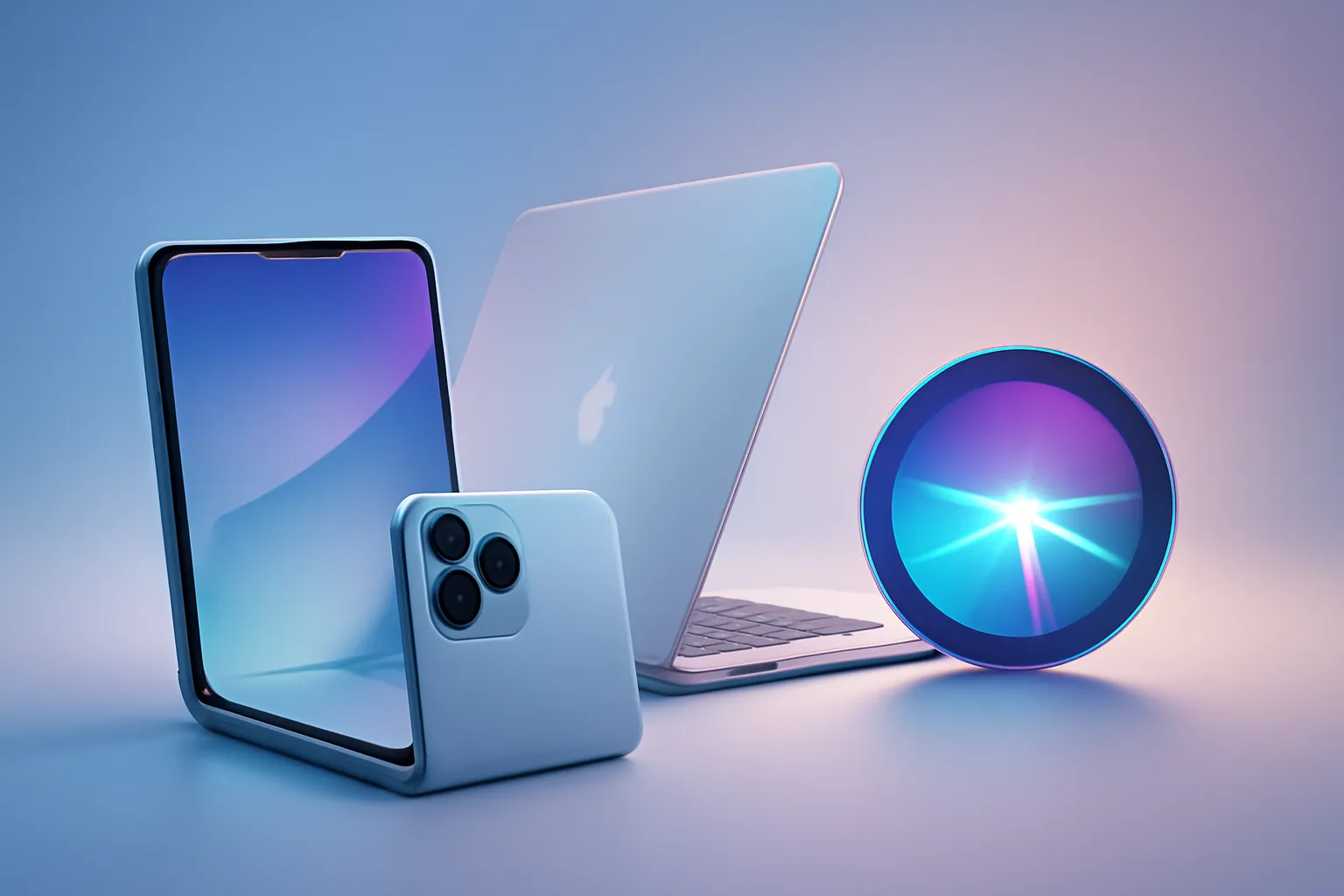
The foldable iPhone is the most obvious symbol of Apple's 2026 launches, but what matters is the "how". The described format is book-like: large inner screen (approx. 7.6") and a more compact outer screen (approx. 5.3"). The implicit promise is to transform the iPhone into a mini-tablet when opened, without having to carry two devices. The risk is also well-known: hinge durability, crease marks and repair costs. Rumours point to a Liquidmetal hinge and an "almost invisible" crease, but that only validates in real-world use. Interestingly, the foldable might forgo Face ID and opt for Touch ID on a side button. Touch ID is fingerprint authentication; on a foldable, it could be a pragmatic choice to save internal space and simplify screen architecture. For those using Face ID for payments and unlock, it would be a habit change: not necessarily worse, but different. At the other end, the iPhone 17e (early 2026) emerges as the entry piece. Rumours speak of slimmer bezels and possible Dynamic Island (or not), and a return of MagSafe. MagSafe is Apple's magnetic system for charger and accessory alignment; for many, it's the detail that decides cases, stands and charging bases. If the 17e brings back MagSafe, it becomes more "compatible" with the recent accessory ecosystem. As for the iPhone 18 Pro (September), the focus is less "new design" and more refinement: screen with Face ID under the panel, A20 chip and possible photography improvements with variable aperture on the main lens. Variable aperture means controlling how much light enters the camera; it can improve low-light shots and give more control over depth of field, but it also adds mechanical and processing complexity.Ecosystem Integration: smart home, iPad and wearables
Apple's 2026 launches also seem to bet on the home. A "home hub" with 7" screen and widgets, designed for device control, calls and contextual information, could be the missing piece between HomePod, Apple TV and HomeKit. The idea of presence (the screen changes when someone approaches) is useful, but raises privacy questions: what sensors exist, what data stays local and what goes to the cloud? Without official details, it's worth being cautious and waiting for clear documentation on permissions and data retention. On iPad, the most relevant rumour is a "base" iPad with A19 chip and capacity for Apple Intelligence (which implies, according to the source text, a higher RAM threshold). For those buying cheap iPad for school or consumption, this could be the first "invisible" leap that counts: it's not the screen, it's the longevity of AI features on the system. On iPad mini, the possible transition to OLED and improved water resistance suggest a repositioning: less "cute small tablet", more "premium small tablet". In wearables, there are two narrative threads: Apple Watch with incremental evolution and ongoing work on non-invasive glucose measurement (no guaranteed date), and AI smart glasses, possibly unveiled in 2026 but arriving later. Without a screen, these glasses would be more "audio/visual assistant" than "augmented reality", and would depend on iPhone for processing: which may limit autonomy, but simplifies weight and heat.Rumours & Development: Siri with LLM and the domino effect on iOS
If there's a centre of gravity in Apple's 2026 launches, it might lie in software: iOS 26.4 (spring) is flagged as the moment when LLM-based Siri arrives. LLM (Large Language Model) is an AI model trained to understand and generate natural language, allowing more flexible responses and execution of more complex tasks. The promise is clear: personal context (emails, messages, files), awareness of what's on screen and deeper integration between apps. The practical impact depends on two things: quality and trust. Quality means fewer wrong answers and more actions completed without friction. Trust means transparency about what's processed on the device, what goes to servers and how "hallucinations" (made-up answers) are avoided. The source text mentions a Google model (Gemini) powering some capabilities, with execution on Apple's infrastructure (Private Cloud Compute) and no data sent to Google. It's a bold claim, but it only gains weight when there's documentation and verifiable privacy controls. This leap in Siri also explains the home hub delay: a kitchen screen that relies on voice commands needs an assistant that understands compound requests and routines. Without it, it becomes just a "fixed tablet".
Next Steps: how to decide purchases and upgrades in 2026
For anyone planning based on Apple's 2026 launches, the most rational decision is to align purchase with need and support window. If you need an iPhone at the start of the year, the 17e could be the entry point, especially if it brings back MagSafe. If you want the biggest design leap, the foldable and September Pros are the candidates: but with the risk of "first generation" and potentially high repair costs. On Mac, a cheaper MacBook might be the option for everyday tasks, but it's worth confirming limitations (LCD screen, lack of ProMotion, and what it means to use an A-series chip in a laptop in terms of apps and sustained performance). Those working with video, photography or development might prefer to wait for M5 Pro/Max or, if OLED/touchscreen confirms, assess whether the screen gain justifies the likely price increase. Finally, if privacy and control are the priority, it's worth closely following how Apple will explain Siri with LLM, permissions and processing. In online purchases, it also makes sense to review terms on timescales and returns before betting early on new hardware; in iOutlet's editorial context, you can consult shipping and processing timescales, the returns policy and warranty information. For transparency, the full list of aggregated rumours is in the original source: MacRumors' 2026 guide. And if you want additional context in iOutlet's archive, there's a summary dedicated to new Apple devices in 2026.FAQ
- Do Apple 2026 launches really include a foldable iPhone?
- It's a strong and recurring rumour, with a window flagged for September 2026, but remains without official confirmation from Apple.
- Will there be a "normal" iPhone 18 in 2026?
- According to the source text, the standard iPhone 18 may be delayed to 2027, with 2026 focused on the foldable and Pro models.
- What does "Siri with LLM" mean in practice?
- It means Siri based on language models, capable of understanding more complex requests and executing actions across apps; the risk lies in reliability and the management of personal data.
- Will the home hub have an App Store?
- The rumour indicates a proprietary system without an App Store, but with Apple's apps in widget format.
- Will the cheaper MacBook replace the MacBook Air?
- There's no indication of that. The idea seems to be to create a step below the Air, with compromises on the screen and possibly on positioning.
- Does the MacBook Pro with OLED arrive in 2026?
- It's described as possible at the end of 2026, but could also slip to early 2027; the window is still uncertain.
Get more articles like this one.
Refurbished tech analysis + €5 with BEMVINDO5 on your first order.