Apple Watch detects atrial fibrillation has gained new relevance from a real‑world clinical trial: over six months, the smartwatch group recorded more arrhythmia diagnoses than the standard‑care group, and more than half of the identified cases were asymptomatic. This matters because atrial fibrillation (A‑Fib) can occur intermittently and silently, raising stroke risk. The study focused on people aged 65+ years with high stroke risk, a profile where missing episodes is especially problematic.
In this article
Overview: what the study tested and what it found
The study, released by Amsterdam University Medical Center, compared two groups: 219 people received an Apple Watch and 218 followed standard care. All were 65 years or older with high stroke risk. Monitoring lasted six months; in the watch group, participants used the device for about 12 hours per day.
In total, arrhythmias were diagnosed in 21 people in the Apple Watch group and in five people in the standard‑care group. A finding that shifts clinical interpretation: in the watch group, 57% of those diagnosed had been asymptomatic before detection; in the standard‑care group, all detected cases had symptoms that prompted a doctor visit.
The key point is not that the watch “treats” anything, but that it can shorten the time to diagnosis when an arrhythmia appears and disappears. This precise scenario makes Apple Watch detection of atrial fibrillation relevant for opportunistic screening in selected populations.
Technical details: PPG and ECG on the wrist (and what each measures)
The latest Apple Watch models include two distinct capabilities for cardiac monitoring:
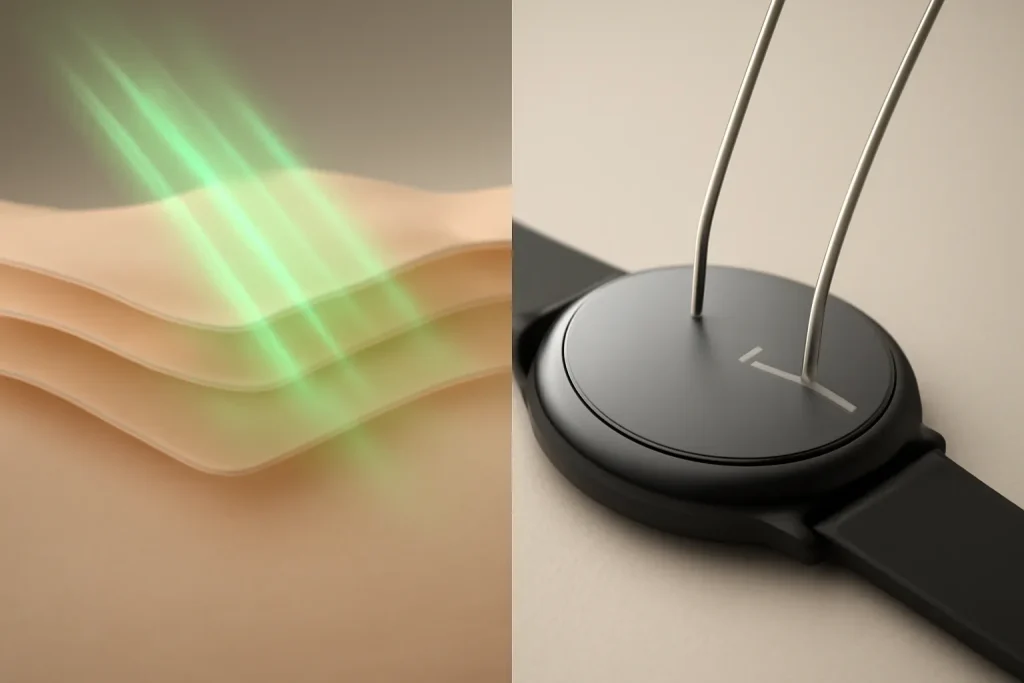
PPG (photoplethysmography): it is an optical method that estimates heart rate and pulse variability by measuring changes in blood volume beneath the skin. In practice, it is useful for flagging pulse irregularities throughout the day with minimal user effort.
ECG of 1 lead: it is a simplified electrical recording of the heart, taken via contact on the watch (typically with a finger on the crown). A single lead does not replace a clinical ECG of 12 leads, but can capture episodes suggestive of atrial fibrillation when they occur.
The value of the combination lies in the “team‑work” approach: PPG can raise suspicions of irregularity passively; ECG can serve as a point‑in‑time confirmation when the user performs a measurement. This workflow helps explain why Apple Watch detection of atrial fibrillation can work better than a brief snapshot taken in a clinic, when episodes are rare or intermittent.
Real‑world use cases: why atrial fibrillation goes unnoticed
Atrial fibrillation is described as an irregular “tremor” in the heart’s upper chambers (the atria). The issue is not just the rhythm: when the atrium fails to contract effectively, blood can pool and form clots that may travel and cause a stroke. The American Heart Association cites an increased stroke risk associated with A‑Fib; the original article reports a five‑fold increase.
The clinical challenge is that about half of cases can be intermittent and asymptomatic. A person may feel fine yet experience short episodes that do not coincide with a consultation or test. In these situations, Apple Watch detection of atrial fibrillation becomes an “opportunity” tool: it raises the chance of catching the event when it occurs.
There is also a practical dimension: traditional long‑term monitoring alternatives may require adhesive electrodes, bulky monitors, or, in selected cases, temporary implantable devices. A watch is easier to wear in daily life, which aids adherence, and adherence is crucial when the goal is to capture rare events.
Limitations & challenges: what the watch does not solve
There are three important limits to keep expectations realistic:
1) It is not a final diagnosis on its own. Even with wrist‑ECG, clinical decisions require medical confirmation and context. Apple Watch detection of atrial fibrillation can speed up suspicion and episode documentation, but it does not replace medical assessment.
2) Study population is “selected”. The participants were 65+ and had high stroke risk. This does not automatically prove the same benefit for younger individuals, athletes, or users without risk factors. The screening gain depends heavily on who is screened.
3) Episodes and artefacts. Wrist measurements can be affected by interference (movement, poor contact, moist skin, etc.). In practice, this can generate alerts that require confirmation, and the user experience depends on how they interpret and act on notifications.
The study points to a potential systemic benefit (fewer strokes and lower costs), but this depends on the next step: confirmed diagnosis, risk stratification and, when indicated, therapy such as anticoagulants. The article also notes that a significant proportion of people who should be anticoagulated may not be, a reminder that technology only adds value when it links the alert to effective care.
What changes for the user: practical decisions and next steps
For those considering using the watch as support, the useful question is: “what do I do with the information?” If the aim is Apple Watch detection of atrial fibrillation, it makes sense to align expectations and routines:
Speak with your doctor if you are 65+ years old, have stroke risk factors, palpitations, episodes of dizziness, unexplained shortness of breath or a family history. A smartwatch can complement monitoring, not replace a consultation.
Use the watch consistently (the study reports 12 hours/day). Intermittent episodes require a “window” of time to be captured.
Log context: if an alert arises, note symptoms, time and activity. Contextual information helps the doctor interpret the event.
Privacy and sharing: before exporting or sharing records, confirm with whom and for what purpose. If you need to clarify purchase terms and post‑sale support in Portugal, consult the pages of warranty conditions and returns policy of iOutlet, for example, to avoid administrative surprises.

For editorial transparency, the clinical trial summary was released in a news article: original news article (HealthDay/US News). For operational details on device features and limitations, the manufacturer’s documentation is a good starting point: Apple’s official support.
The bottom line: Apple Watch detection of atrial fibrillation appears to increase the likelihood of identifying silent cases in high‑risk individuals, but the real benefit depends on clinical follow‑up. The watch can open the door; preventing stroke requires confirmed diagnosis and appropriate treatment when indicated.
FAQ
- Does the Apple Watch “diagnose” atrial fibrillation?
- It does not replace a medical diagnosis. It can detect compatible signals (via PPG and ECG of 1 lead) and help document episodes, but confirmation and therapeutic decisions are clinical.
- Who benefits most from Apple Watch detection of atrial fibrillation?
- In the cited clinical trial, the benefit was observed in a selected population: people with 65+ years and high stroke risk. In low‑risk profiles, the value may be lower and the chance of inconclusive alerts may weigh more.
- If I have no symptoms, can I still have atrial fibrillation?
- Yes. The study reported that more than half of the cases diagnosed in the Apple Watch group were asymptomatic before detection, which aligns with the intermittent, silent nature of A‑Fib in many people.
- What should I do if I receive an irregular rhythm alert?
- Avoid drawing immediate conclusions. Log the time and what you were doing, and contact your doctor for guidance. If you have severe symptoms (chest pain, fainting, intense shortness of breath), seek urgent care.
- Why might a clinic ECG miss the problem?
- An ECG performed at a consultation is a brief “snapshot” of a few seconds. If the arrhythmia is intermittent, it may not be present at that moment; day‑long monitoring increases the chance of capturing episodes.
- Does using the watch more hours per day make a difference?
- In theory, yes: more wear time means more opportunities to detect rare episodes. In the study, users wore the watch for about 12 hours per day, which helps explain the higher detection rate.
These health features are available on several models: see the iOutlet refurbished Apple Watch, tested and with warranty.
Get more articles like this one.
Refurbished tech analysis + €5 with BEMVINDO5 on your first order.