In this article
- Global Vision: why Apple is betting on the living room
- Architecture & Specifications: A17 Pro, the piece that unlocks Apple Intelligence
- Ecosystem Integration: Continuity Keyboard and the 'small' big improvement
- Connectivity and Smart Home: the role of the N1 chip and Thread
- Multimedia and Camera: between Dolby Vision 2 and FaceTime on the big screen
- What changes for the user: realistic scenarios with Apple Intelligence on TV
- Next Steps: what to do now (without impulse buying)
- FAQ

Global Vision: why Apple is betting on the living room
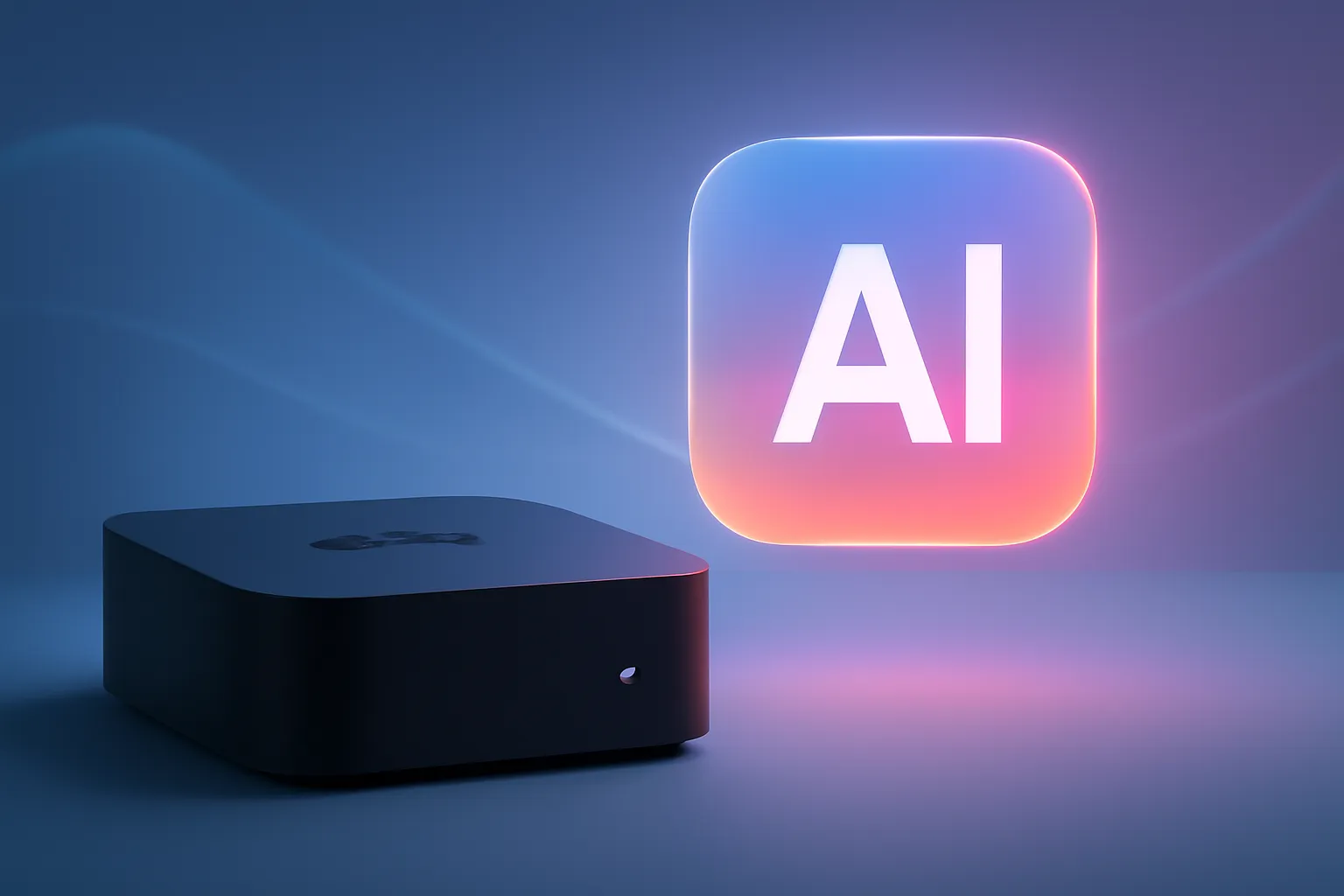
In recent years, Apple TV 4K has been a competent but predictable product: good performance, solid interface and a focus on streaming. An Apple TV 4K with Apple Intelligence would shift the device's centre of gravity, moving it closer to a home 'hub' – not just for watching content, but for coordinating tasks, automations and voice interactions. When we talk about Apple Intelligence, we're talking about a set of Apple AI features (including on-device processing and service integration) designed to understand requests, generate responses and execute contextual actions. On a television, practical value depends less on 'special effects' and more on reducing friction: finding content, filling in text, controlling the home and managing routines without endless menus. Timing is also relevant: indications point to a presentation in the first half of 2026, possibly between March and April. The very delay suggested in the source material reinforces one interpretation: Apple doesn't want to launch hardware 'ready for AI' without the Siri layer capable of justifying it.Architecture & Specifications: A17 Pro, the piece that unlocks Apple Intelligence
The most consistent rumour is the swap from the current model's A15 Bionic to an A17 Pro. Without getting into numbers, the implication is clear: more CPU/GPU capacity and, above all, more headroom for AI tasks and local automation. It's also mentioned that the A17 Pro would be the 'bare minimum' to run Apple Intelligence, which helps explain two likely consequences. First: the Apple TV 4K with Apple Intelligence could become the performance benchmark within the tvOS line, with faster responses in search, recommendations and system tasks. Second: earlier models could be limited to the current Siri experience, without the full AI package – typical segmentation when hardware requirements increase. There's also an important clue: the reliance on a more advanced Siri associated with iOS 26.4. In practical terms, this suggests Apple wants to align the experience across devices, so that requests made on the iPhone 'carry over' to the TV, and vice versa, with genuine continuity and less command repetition.
Ecosystem Integration: Continuity Keyboard and the 'small' big improvement
One of the most concrete mentions is the arrival of Continuity Keyboard, allowing you to use an iPhone or iPad as a keyboard for typing on the TV. It may seem like a detail, but it solves an old problem: entering passwords, searching for long titles or typing text with the remote is slow and annoying. With Apple TV 4K with Apple Intelligence, this integration makes even more sense: AI can suggest, complete and accelerate actions, but still needs input. If input is easier, the likelihood of people using 'smart' features increases. It's the kind of improvement that doesn't appear on posters, but changes daily use. The ecosystem also weighs in here: those who switch between iPhone, iPad and TV tend to benefit more. For those who use Android as their main phone, the proposition may lose some of its shine, even though the box continues to be strong on streaming.Connectivity and Smart Home: the role of the N1 chip and Thread
The text mentions the possible adoption of an N1 chip for communications, responsible for Wi‑Fi, Bluetooth and Thread. Thread is a low-latency, low-power network protocol designed for smart home devices (sensors, lights, locks), with a focus on reliability and mesh networks. If this piece is confirmed, the Apple TV 4K with Apple Intelligence could gain relevance as a stable node in the home network, helping routines and controls to work with fewer failures. In practice, this translates to more consistent actions: voice commands that don't 'hang', automations that trigger first time and less reliance on a single device as a 'bridge'. It's also a way for Apple to strengthen its Apple Home strategy, positioning the TV as an always-on device with good range and coordination capability. Still, it's wise to keep expectations in check: better connectivity doesn't solve poor accessory integrations or unstable Wi‑Fi networks on its own.Multimedia and Camera: between Dolby Vision 2 and FaceTime on the big screen
On the audiovisual side, support for Dolby Vision 2 is mentioned as a possibility. Without official confirmation, the prudent reading is: Apple may want to align the Apple TV 4K with Apple Intelligence with new standards and noticeable improvements on screen, so the leap doesn't seem 'just AI'. Another possibility is even more interesting: a model with an integrated camera. tvOS 26 will have already strengthened FaceTime-related features, which opens the door to video calls directly on the TV, without relying on external accessories. The caveat in the material is important: the camera could be reserved for a more advanced version, suggesting segmentation by price and features. If Apple goes ahead, the discussion becomes more than just technical and also touches on privacy: a camera in the living room requires clear controls (indicators, permissions, disable), and transparent communication about what is processed locally and what leaves the device.What changes for the user: realistic scenarios with Apple Intelligence on TV
The best test of Apple TV 4K with Apple Intelligence is to ask: what would I do differently tomorrow? Some plausible scenarios, if the 'new Siri' delivers on the promise: 1) Search by intent: 'I want a short, light film to watch with children' instead of browsing by category. 2) Compound commands: 'play the series from the episode where I left off and dim the lights' (if smart home is integrated). 3) End-of-day routines: turn off devices, activate silent modes and set alarms, from the TV. 4) Less friction in setup: passwords and logins with Continuity Keyboard, avoiding the on-screen keyboard. The flip side is compatibility: if Apple Intelligence requires an A17 Pro, those with earlier models likely won't get the same set of features. For many users, that will be the real 'upgrade trigger'.
Next Steps: what to do now (without impulse buying)
Until there is official confirmation, Apple TV 4K with Apple Intelligence should be seen as a likely scenario, not a guarantee. Still, there are practical decisions that already make sense. If you're thinking about buying an Apple TV 4K in the coming months, consider the timing: if your priority is advanced AI/Siri and smart home integration, it may be worth waiting for 2026. If the goal is just stable streaming, the current model can continue to serve well. For those who already have an Apple TV 4K, the best 'preparation' is to get the basics in order: solid Wi‑Fi network, compatible accessories and well-defined routines. And, as a rule of informed consumption, always confirm purchase conditions, timescales and coverage – for example, the pages on warranty conditions, returns policy and shipping times help reduce surprises, whatever equipment you choose. For editorial transparency, the starting point of this information is in the original article: original source.FAQ
- Is Apple TV 4K with Apple Intelligence already confirmed by Apple?
- No. The scenario described is based on code clues and information leaks. Until there is an official announcement, it should be treated as a rumour/expectation.
- Will Apple TV 4K with Apple Intelligence force you to have an iPhone?
- Not necessarily to work, but several integrations (such as Continuity Keyboard) make more sense and tend to be more useful with an iPhone or iPad in the ecosystem.
- Is the A17 Pro really necessary for Apple Intelligence on Apple TV?
- That's what the material suggests as the minimum requirement. Without official confirmation, the prudent reading is that Apple may require more recent hardware to run AI with good performance and privacy.
- Will older Apple TV 4K models lose out on the new features?
- Possibly. The text indicates that earlier models could be limited to the current Siri experience, without the full set of Apple Intelligence, if the hardware requirement is confirmed.
- What is Thread and why does it matter in an Apple TV 4K with Apple Intelligence?
- Thread is a smart home network protocol designed for more reliable connections with low latency. If Apple TV integrates Thread better, it could serve as a more stable component for routines and accessory control.
- Is an integrated camera in Apple TV 4K with Apple Intelligence likely?
- It's a possibility mentioned, reinforced by FaceTime news on tvOS. Still, it could be reserved for a more advanced version if Apple chooses to segment the range.
Get more articles like this one.
Refurbished tech analysis + €5 with BEMVINDO5 on your first order.