In this article

Overview
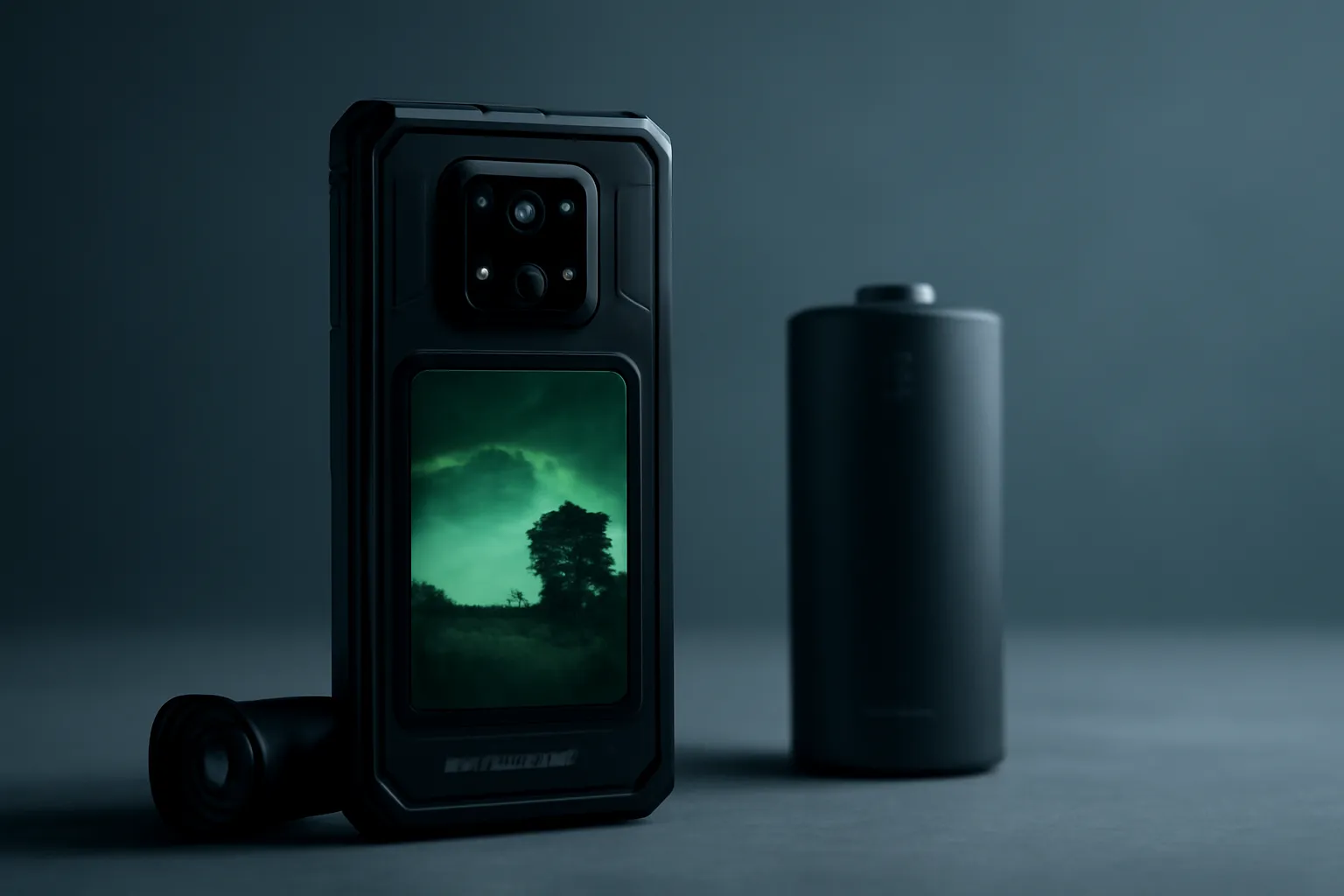
What sets the FOSSIBOT F113 night‑vision smartphone apart is not just “another night mode” typical of computational photography. This is a dedicated infrared module designed to capture images when illumination is insufficient for conventional sensors. In practice, the approach resembles a night‑vision camera more than a traditional smartphone: rather than trying to “reconstruct” the scene with software, it relies on light outside the visible spectrum (infrared) to form an image. This positioning makes sense in concrete scenarios: inspections in unlit warehouses, security patrols, camping, early‑morning or dusk trail exploration, or technical tasks in spaces where using a torch is inconvenient. It also explains the choice of a rugged body and a battery far beyond what is seen in conventional smartphones.Architecture & Specifications
According to the disclosed information, the FOSSIBOT F113 night‑vision smartphone combines three key components in the imaging block. First, a Sony IMX766 sensor for 50MP photography and video 4K, a sensor known in the Android ecosystem for balancing detail and performance in difficult light (although the final result depends as much on processing as on optics). Next, a macro lens of 5MP for close‑up work. Finally, an infrared system of 64MP aimed at low‑light conditions, with an announced reach of up to 50 metres. It is worth clarifying terms: “infrared” (IR) is electromagnetic radiation with a wavelength longer than visible light. In photography, an IR system can capture information when the human eye can no longer see, but the result tends to differ from “night mode”, often with a monochrome appearance, distinct contrast and reduced colour fidelity (because, literally, it does not capture visible colour). The indicated reach (up to 50 metres) is relevant for observation and recording uses, but it does not tell the whole story. Real quality depends on factors such as the power/efficiency of the IR illuminator (if present), sensor noise, stability, and the type of scene (fog, rain and dust can degrade the image considerably). This is where the FOSSIBOT F113 night‑vision smartphone can shine in utility tasks, even if it does not replace a dedicated camera in demanding professional contexts.
Practical Advantages
There are three clear advantages to the FOSSIBOT F113 night‑vision smartphone concept. The first is operational: having night vision in the same device that already carries communications, maps and work apps reduces extra gear. The second is endurance: an announced battery of 20.000mAh, with standby and prolonged‑use reference figures, suggests a profile designed for several days off the grid. The third is energy versatility: reverse charging (18W, according to shared information) turns the phone into an emergency powerbank for critical accessories. For field workers, this can translate into fewer stops and fewer “single points of failure”. The macro lens is also useful in maintenance: photographing serial numbers, cracks, connectors or small components without relying on digital zoom.Limitations & Challenges
The FOSSIBOT F113 night‑vision smartphone also brings trade‑offs worth noting. The first is physical: a battery of this capacity inevitably adds weight and volume. That affects pocket comfort, mounting on rigs and one‑handed prolonged use. The second is image expectation. Infrared night vision is not “night as if it were day”; it is a different way of seeing. It can excel at identifying shapes, movement and presence, but may fall short on fine detail at long range, especially in adverse atmospheric conditions. The third is privacy and usage context. Devices capable of dark capture can be misinterpreted in public or private spaces. If the FOSSIBOT F113 night‑vision smartphone is used for work, it makes sense to set internal rules: where capture is permitted, how images are stored, and for how long. In sensitive environments, transparency with teams and clients prevents unnecessary issues.What changes for the user
For the average user, the biggest shift is understanding that this type of product does not aim to compete with “flagship” social photography; it seeks to solve a specific problem: seeing and recording when light does not help. If that is your issue, the FOSSIBOT F113 night‑vision smartphone may be more useful than a top‑of‑the‑range device without IR, even if it compromises ergonomics or day‑to‑day camera “refinement”. For technical and operations teams, the impact can be even more direct: less reliance on torches, fewer trips to the car for equipment, and a single tool for documentation (photo/video), communication and emergency power.
Next Steps
If you are considering a FOSSIBOT F113 night‑vision smartphone, the next step is to validate its fit for your real scenario: do you need IR for identification/inspection or just good night photography? Do you work at distances that justify the announced range? And can you live with the more “tank‑like” form factor typical of rugged devices? Before deciding, it is also wise to confirm the warranty and return policies applicable to your case. In the editorial context of iOutlet, it may be useful to review warranty conditions and return policies, especially if the purchase depends on testing night vision in the field. For transparency, the original listing description can be consulted at original source. In summary, the FOSSIBOT F113 night‑vision smartphone is a specialised tool masquerading as a phone. When work (or adventure) takes place in the dark and away from power outlets, the proposition shifts from curiosity to utility.FAQ
- Does the FOSSIBOT F113 night‑vision smartphone see in total darkness?
- It depends on the infrared system and the scenario. In general, IR night vision can work with little or no visible light, but quality varies with distance, atmospheric conditions and the type of surface or object.
- Does the infrared camera replace the normal night mode?
- It is not the same thing. Night mode tries to preserve colour and natural appearance through processing; infrared captures outside the visible spectrum and tends to produce results with a different aesthetic, more utilitarian.
- Do the 50 metres of reach mean a sharp image at 50 metres?
- “Reach” usually refers to the ability to detect subjects, not necessarily fine detail. Sharpness and legibility depend on IR illumination, stability, noise and scene contrast.
- Does a battery of 20.000mAh imply the phone is heavy?
- It is a likely consequence. Larger batteries take up space and add mass, which can affect comfort and portability, even if they are advantageous for endurance.
- What is reverse charging for in practice?
- It allows the phone to charge other devices (for example, earbuds, a dedicated GPS or another smartphone) in emergency situations, acting as a powerbank.
- Are there privacy risks when using night vision on a smartphone?
- There are perception and misuse risks, especially in private spaces. In a professional context, it is recommended to define clear rules for capture, storage and sharing of images.
Get more articles like this one.
Refurbished tech analysis + €5 with BEMVINDO5 on your first order.